
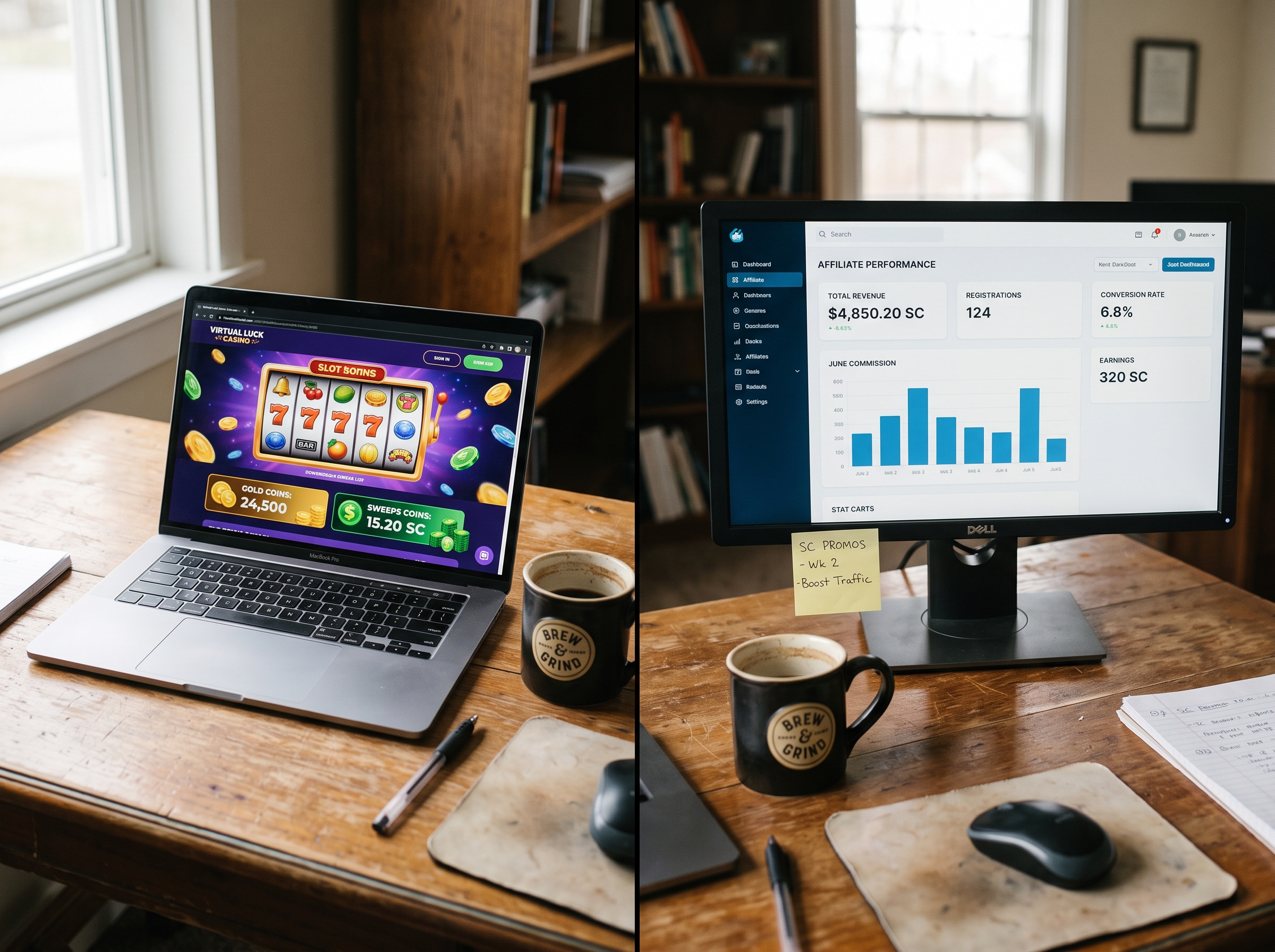
Sweepstakes casinos hit roughly $7 billion in annual player spend at their 2025 peak, per Eilers & Krejcik data. That’s a market the size of a mid-tier US state lottery - and yet, most affiliates are still grinding the same crowded real-money casino keywords, fighting over the same bonus-hunter traffic.
Sweepstakes casino affiliate programs are a parallel economy. Same traffic sources. Different commission mechanics. Far less competition for top content positions.
So why isn’t every affiliate already promoting them?
A sweepstakes casino is a US-facing online gaming platform that operates under promotional sweepstakes law, not gambling licenses. Players purchase Gold Coins for entertainment play and receive Sweeps Coins for free - and Sweeps Coins can be redeemed for real cash. For affiliates, that means commissions on Gold Coin purchases, not gambling deposits. Same traffic. Different legal wrapper.
In this guide, we’ll explain how the sweepstakes model actually works, what affiliates earn across CPA, RevShare, and hybrid deals, how Chumba, Pulsz, and McLuck compare as affiliate programs, and what the 2026 regulatory wave means for your traffic strategy.
Last updated: July 2026
What is a sweepstakes casino - and why should affiliates care?
The core mechanic is a dual-currency system. Gold Coins are the entertainment currency - purchased in packages from $1.99 to $99.99, used to play slots and table games, and never redeemable for cash. Think in-app purchases in a mobile game: you’re buying play time, not gambling chips.
Sweeps Coins are the prize currency. They’re received for free - as a bonus with Gold Coin purchases or via Alternative Method of Entry (AMOE) - and can be redeemed for real cash at roughly 1 SC = $1, above a 50 SC threshold.
The AMOE is the legal engine. Under FTC promotional sweepstakes rules, a sweepstakes is legal if three conditions hold: no purchase necessary, real prize value, and chance-based outcome. Free entry paths - historically mail-in postcards, now also digital web forms - remove “consideration” from the gambling definition.
For affiliates, the conversion event is the first Gold Coin purchase. That’s simpler than a casino deposit: no KYC friction, no payment-method matching problem. Lower barrier, higher volume potential. And as we’ve covered in our payment methods conversion analysis, reducing friction at the conversion point is the single biggest lever in affiliate marketing - and sweepstakes purchases are about as low-friction as it gets.
But here’s the number that should make you pay attention: 75% of sweepstakes players never make a Gold Coin purchase at all, per Track360’s 2026 pillar research. They play entirely through free Sweeps Coins. The conversion from free to paying player is the metric that matters - and that’s where high-quality affiliate traffic separates from bonus-hunter traffic.
How sweepstakes affiliate commissions actually work
Three models dominate. Which one fits your traffic depends on volume, player quality, and how long you’re willing to wait for payout.
CPA (Cost Per Acquisition). A flat fee per first Gold Coin purchase. Ranges run $25 to $120 across tiers. Tier 1 brands - Chumba, Stake.us, McLuck - pay $50 to $120. Tier 2 operators like Pulsz sit at $30 to $75. Tier 3 newcomers offer $25 to $60 with promotional sweeteners. Published rates lag negotiated rates by 30 to 60% for proven partners.
RevShare (Revenue Share). The 2026 industry norm is 25 to 35% of net purchase revenue - Gold Coin purchases minus Sweeps Coin redemptions, chargebacks, and processing fees. This is where understanding the difference between NGR and GGR pays off. Redemption netting - subtracting player cash-outs from your commission base - is the single most important line item in any sweepstakes affiliate agreement. A program that doesn’t net redemptions won’t last.
Hybrid (CPA + RevShare). The 2026 standard for mid-tier partners: typically $15 to $60 CPA plus 15 to 25% RevShare. Most affiliates who’ve been in sweepstakes more than twelve months end up here - pure CPA leaves too much long-term value on the table once you can model lifetime value.
For example:
Campaign A runs pure CPA at $75 per first purchase. 100 conversions - that’s $7,500, clean and simple.
Campaign B runs hybrid at $30 CPA plus 20% RevShare. Same 100 conversions. That’s $3,000 upfront, plus recurring revenue from players who keep buying Gold Coin packages. After six months, Campaign B often outperforms by 40% or more.
That’s the math most affiliates miss. CPA looks bigger on day one. RevShare builds wealth over time.
Chumba, Pulsz, and McLuck - three programs, three strategies
These three brands cover most of the sweepstakes affiliate market. They don’t compete for the same player - they compete for different segments of the same funnel.
Chumba (VGW Holdings) is the incumbent. Longest track record, most consistent payout reliability, strictest content guidelines. CPA runs $25 to $100 typical, RevShare at 25 to 30%. Hybrid reserved for established partners. Chumba works best when your audience already knows the category and trusts the name.
Pulsz (Yellow Social Interactive) is the mid-funnel specialist. CPA at $30 to $120 with segmented tiers, RevShare at 25 to 35%. Hybrid terms are more accessible to mid-tier affiliates. Pulsz converts best when your audience knows the category but hasn’t picked a brand. Game-library content - slot variety comparisons, jackpot tracking - consistently beats brand-history narratives for Pulsz referrals.
McLuck (B-Two Operations) is the aggressive newcomer. CPA at $30 to $120 with sign-up promo tiers, RevShare at 25 to 35% with flexible structures. Most willing of the three to extend hybrid terms to mid-tier sign-ups. Crypto-denominated payouts are available - a meaningful differentiator if your audience skews younger and crypto-aware, and something we explored in depth in our crypto vs e-wallet affiliate payouts comparison. YouTube reviews and Reddit threads drive McLuck conversions more effectively than traditional SEO content.
The operational signals that matter more than headline rates: postback fire latency, payload completeness (is redemption-adjusted revenue in the payload?), affiliate manager response time (benchmark: 24 to 48 hours), and payment timeliness. Per Track360’s 2026 operator comparison, these signals predict program quality more reliably than any published CPA number.
The regulatory wave - what 2026’s state bans mean for your affiliate business
The map is shifting fast. As of mid-2026, at least eight US states have enacted explicit bans on the dual-currency model: California, New York, New Jersey, Connecticut, Montana, Indiana, and Maine joined pre-existing restrictions in Washington, Idaho, Nevada, and Michigan, according to DLA Piper’s regulatory analysis.
California’s AB 831 is the one that should keep you up at night. It extends liability to affiliates themselves - criminal misdemeanor, fines of $1,000 to $25,000, up to one year imprisonment, plus civil liability under California’s Unfair Competition Law at $2,500 per violation. That is not theoretical.
The market contraction is real. Eilers & Krejcik revised their 2026 projection from roughly $6.9 billion peak gross to approximately $3.6 billion net - about $1 billion in addressable revenue evaporated from state bans. California alone represented roughly 20% of US sweepstakes revenue before AB 831.
What affiliates must do now: audit your geo-targeted content. A page ranking for “best sweepstakes casinos in California” is a liability, not an asset. Verify that your tracking fires geo-validation before counting a conversion - no commission for players in excluded states. Use compliant terminology: “purchases and redemptions,” never “deposits and withdrawals.” Those four words separate a promotional sweepstakes from an unlicensed gambling operation.
The glass-half-full take: contraction doesn’t kill the opportunity. It separates careful affiliates from reckless ones. Operators still running in permitted states need compliant traffic more than ever - and they’ll pay for it.
Where sweepstakes affiliate traffic actually comes from
Different channels produce different player quality. The channel you pick shapes your commission model as much as the operator you pick.
SEO and review portals are the durable backbone. Ranked content keeps sending players months after publication. But Google’s early 2026 updates hit iGaming affiliates hard - 71% saw negative impact from the March core update, per iGB Affiliate. Thin comparison pages dropped 30 to 50% in visibility. What works now: original data, named expert authors, and first-hand platform testing - content that demonstrates actual experience rather than rewording operator marketing pages.
Streaming creators on Twitch, Kick, and YouTube convert audiences that ad copy never reaches. Hybrid deals work best - a CPA floor protects the creator’s upfront effort, a RevShare tail rewards audience quality. Engagement rate matters more than follower count.
Paid media is path-dependent. Facebook works if framed as social casino, not gambling. Native networks - Taboola, Outbrain - remain viable for advertorial funnels.
Reddit and owned communities are the highest-intent channels by conversion rate. Subreddits like r/SocialCasino are niche but convert at rates that make broad SEO traffic look wasteful. Owned channels - Telegram groups, email lists - show 30% lower bounce rates and 45% higher page depth than referral traffic, per iGB Affiliate data. If you’re not building an owned audience alongside your content strategy, you’re leaving the highest-value traffic on the table.
At Paynura - one dashboard, every sweepstakes deal you need
At Paynura, we help affiliates access sweepstakes casino deals from a single dashboard. More than 3,000 registered affiliates. 145,000 tagged accounts. Annual deposit volume exceeding $150 million.
We bring operator deals to affiliates - it’s the model we’ve run since day one, whether for crypto casinos like BC.GAME’s hybrid CPA + RevShare deal or for the sweepstakes programs covered in this guide. Instead of negotiating individual deals with each operator - comparing redemption-netting terms across five different portals, chasing affiliate managers for updated rate cards - you get side-by-side comparison, transparent terms, and hybrid structures that reward long-term player value.
No more waiting for monthly commissions. With Paynura, you get paid when you say so.
Join Paynura today and start earning from sweepstakes and social casino affiliate deals.
Frequently asked questions
What is a sweepstakes casino affiliate program?
A partner program where sweepstakes casinos pay affiliates for referring players who register and purchase Gold Coin packages. Unlike traditional casino programs, commissions are based on virtual-currency purchases, not gambling deposits.
How do commissions work in sweepstakes affiliate programs?
Three models: CPA (flat fee per first Gold Coin purchase, $25 to $120), RevShare (25 to 35% of net purchase revenue, ongoing), and Hybrid (typically $15 to $60 CPA plus 15 to 25% RevShare). Redemption netting - subtracting Sweeps Coin cash-outs from revenue - is standard in sweepstakes RevShare agreements.
Are sweepstakes casinos legal in the US?
They operate under FTC promotional sweepstakes rules, not gambling licenses. However, at least eight US states have banned the dual-currency model as of mid-2026, including California, New York, and New Jersey. Affiliates must geo-validate their traffic - California’s AB 831 extends liability to affiliates themselves, with criminal penalties possible.
What’s the difference between Gold Coins and Sweeps Coins?
Gold Coins are purchased for entertainment play and can never be redeemed for cash. Sweeps Coins are received for free - via purchase bonuses or Alternative Method of Entry - and can be redeemed for real cash at roughly 1 SC = $1, above a 50 SC threshold. Affiliate commissions are based on Gold Coin purchases.
Which sweepstakes casino has the best affiliate program?
It depends on your audience. Chumba offers the most operational stability and longest payout track record. Pulsz is the strongest mid-funnel option with competitive tiered RevShare. McLuck offers the most aggressive entry terms, including crypto payouts and flexible hybrid deals for new affiliates. The right program matches the players you already reach.
Can I promote sweepstakes casinos from outside the US?
Yes - the sweepstakes model is accessible to international affiliates. But your players must be in permitted US states for conversions to count. Geo-validation at the tracking layer is critical: if your traffic includes restricted-state visitors, those clicks won’t convert and you won’t get paid. Most operators require US-based payment details for player redemptions.
Turn Clicks Into Real Affiliate Revenue
The sweepstakes vertical generated billions in player spend - and while the regulatory map is shifting, the operators still standing need compliant, high-quality traffic more than ever. At Paynura, you get access to sweepstakes casino affiliate deals from one dashboard, with transparent terms and faster payouts than going direct.
Join Paynura today and start earning from sweepstakes casino affiliate programs >>
Let’s talk: @paynura