
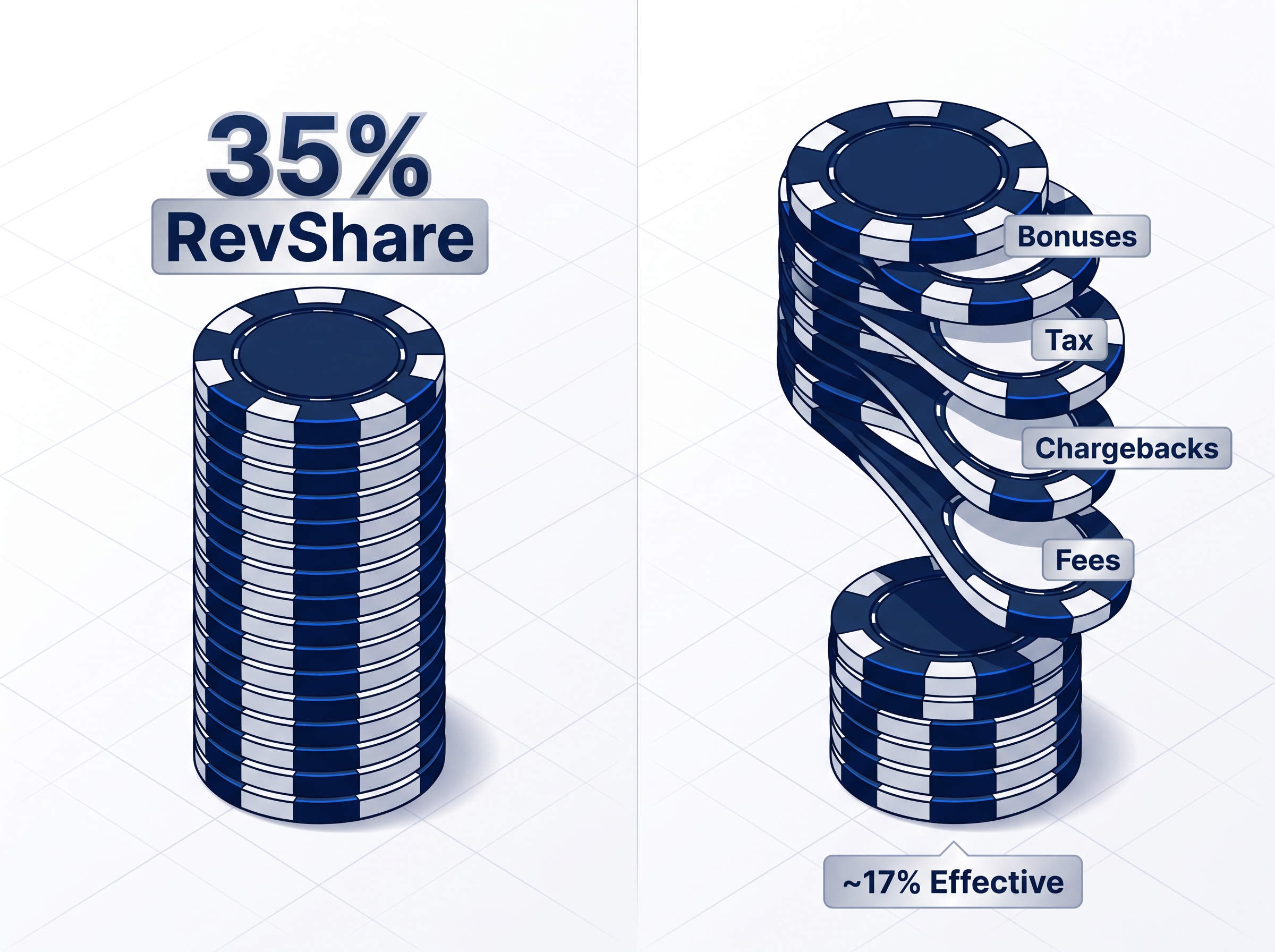
You’ve seen the number. 35% RevShare. You did the mental math — if your players lose $10,000 this month, that’s $3,500 in your pocket. Clean, simple, exciting.
Except that’s not how any of this works.
The 35% isn’t calculated on what your players lose. It’s calculated on what’s left after the operator pays bonuses, covers chargebacks, settles the tax bill, and deducts costs you probably didn’t know existed. That number — what’s actually left — is called Net Gaming Revenue. And the gap between player losses and your commission base can swallow 15 to 40% of your headline earnings — over 50% in high-tax markets.
That’s where understanding NGR vs GGR comes in.
GGR stands for Gross Gaming Revenue. It’s total wagers minus total winnings — the raw house take before any costs.
NGR stands for Net Gaming Revenue. It’s GGR minus bonuses, chargebacks, gaming taxes, and other contractually agreed deductions — the revenue the operator actually keeps.
This builds on our EPC explainer — once you know what you earn per click, the next question is what you’re earning per player. In this guide, we’ll walk through the deduction waterfall, show why your 35% RevShare probably pays closer to 17%, and give you a checklist for comparing deals on real earnings — not headline percentages.
Last updated: July 2026
GGR vs NGR — what actually disappears between the two numbers
GGR is the easy part. Your players wager, some lose, the operator keeps the difference. At a 94% RTP casino, GGR works out to roughly 3-12% of the handle.
NGR is everything that happens after.
GGR = Total Wagers − Total Winnings
NGR = GGR − Bonuses − Chargebacks − Gaming Tax − Platform Fees − Fraud Holdback
Here’s the part most affiliates miss: NGR is contractually defined, not regulator-defined. Two operators with identical GGR can report wildly different NGR — meaning two “35% RevShare” deals can pay completely different amounts.
So how big is the gap?
Industry data — from operator-side analyses by Track360 and Intelitics — puts the typical GGR-to-NGR gap at 15-40%. In high-tax jurisdictions, it pushes past 50%. If your players generate $10,000 in GGR, the commissionable base might be $6,000 — or $4,500.
The deduction waterfall — step by step, with real numbers
Track360’s 2026 operator deep-dive — the most detailed public breakdown of this sequence — maps it in seven steps. Here’s how it plays out, with real numbers:
Player wagers — the handle. Your referred players deposit and play. The 100% baseline.
Minus winnings — the RTP. At 94-97% RTP, the house keeps 3-6% per dollar wagered. GGR is typically 3-12% of handle.
Minus bonus costs — 15-35% of GGR. Welcome bonuses, deposit matches, free spins. The single biggest deduction, and it spikes during promos.
Here’s the trap: a player who deposits $100 with a 100% match and loses $200 hasn’t generated $200 in clean GGR — the operator’s $100 bonus cost comes straight out of your NGR base. During aggressive campaigns, bonus costs can consume 25-35% of GGR (Atlantic City averaged 16.52% in June 2025).
Bonus hunters can produce negative NGR where bonus costs exceed GGR for a month. If your affiliate agreement has negative carryover, that deficit rolls into next month’s commission.
Minus chargebacks — 1-8%. Disputed transactions, friendly fraud, payment reversals.
Minus gaming taxes — 10-25%+. Varies massively by jurisdiction — the deduction you have the least control over.
Minus platform and provider fees — 5-15%. What the operator pays to NetEnt, Evolution, and their platform vendor. The most disputed deduction — it’s operator overhead, not player-linked.
Minus fraud holdback — 3-8%. Held for 60-90 days pending investigation. You may get some back.
What’s left = commissionable NGR. Often only 2-4% of the original handle.
For example — real numbers through the waterfall:
Your players wager $850,000 at a 94% RTP casino. Winnings paid: $798,000. GGR = $52,000.
From that $52,000: bonuses ($11,700) → chargebacks ($2,015) → Malta gaming tax at 5% ($2,600) → provider fees ($3,300) → platform fee ($800) → fraud holdback ($1,579).
Commissionable NGR: $30,006.
At 25% RevShare on NGR, your commission is $7,502. At 25% on GGR, it’d be $13,000 — nearly 73% more.
At 35% RevShare on NGR: roughly $10,500. At 35% on GGR: $18,200. A 42% difference — all in the waterfall.
Legitimate deductions vs the “operational costs” trap
Not all deductions are equal. Some are player-linked. Others are the operator’s own business costs — and you shouldn’t be paying for them.
The rule, from affiliate-tracking specialists at Scaleo: if a deduction can’t be traced to a player ledger entry, it doesn’t belong in your NGR.
Legitimate (player-linked): bonuses, bonus winnings, payment processing per transaction, documented chargebacks, gaming taxes.
Disputed (operator overhead): platform licensing fees, game provider royalties, “administrative fees,” “risk adjustments,” staff salaries, marketing spend, “other operational costs.”
For example — a real-world dispute: €24,000 GGR → ~€13,000 NGR after legitimate deductions. Expected commission at 35%: €4,550. Actual payment: €1,750. The operator deducted €8,000 in platform fees, provider royalties, and “risk adjustments” — 62% of the legitimate commission, gone.
If the NGR clause says “and other operational costs,” you’re signing up for whatever the operator decides to deduct. Demand an enumerated list where every deduction is traceable.
Jurisdiction matters — not all 35% RevShares are equal
Where your players are located determines the tax burden — and how much NGR survives for your commission. A 35% RevShare on UK traffic is not the same deal as 35% on Curacao.
As of mid-2026:
The UK delivered the single biggest hit to affiliate earnings in any regulated market. Remote Gaming Duty rose from 21% to 40% effective 1 April 2026. Combined with typical bonus costs, the GGR-to-NGR gap on UK traffic can now push past 50% — that “35% RevShare” effectively pays 15-17% of GGR.
Malta, historically affiliate-friendly, is tightening. Casino tax triples from 5% to 15% from 1 October 2026; sports and poker rise to 10%. Operators are recalibrating RevShare rates.
Pennsylvania carries a 36% combined tax burden. With bonuses averaging 16.5% of GGR, over half of gross revenue can disappear before NGR — and that’s before platform fees.
Curacao and offshore jurisdictions carry near-zero gaming tax. The NGR base is widest here — which is why crypto casinos can offer 40-45% RevShare that’s genuinely bigger, not just marketing.
The takeaway: “35% RevShare” on UK players is a fundamentally different deal from “35% RevShare” on Curacao traffic. The headline tells you nothing until you know where the players are.
How to protect yourself — the NGR checklist
You can’t control the operator’s tax bill or bonus spend. But you can control which deals you commit traffic to.
Read the NGR clause. “And other operational costs” means you’re volunteering for an unknown haircut. Ask for the full list — if they won’t provide it, walk.
Demand itemised reporting. Your dashboard should show GGR → each deduction → NGR → commission. If you can’t see the waterfall, you can’t audit it — and if you can’t audit it, you’re taking the operator’s word on faith.
Prefer player-scoped NGR. Better operators calculate NGR per player, then sum across your cohort. That way one fraudulent player doesn’t contaminate your entire month.
Understand negative carryover. Full NCO on NGR-based deals is the fastest way to lose your earnings. We’ve covered this in our negative carryover guide.
Calculate your effective rate. Commission ÷ GGR from your players = your real RevShare percentage. If it’s less than half the headline rate, renegotiate or move your traffic.
At Paynura — compare deals with full transparency
At Paynura, we work with operators across every major jurisdiction — Malta, UK, Curacao, Brazil, and beyond. You’re not locked into one NGR formula. Compare deals side by side, understand what’s being deducted, and choose the programs where your traffic earns the most.
Our network connects over 3,000 affiliates to casino, sportsbook, poker, and e-wallet offers — all from a single dashboard with 145,000+ tagged accounts and $150M+ in annual deposit volume. Whether you’re sending UK sports bettors or crypto casino traffic from LatAm, you deserve to know what you’re actually earning.
Join Paynura today and start comparing RevShare deals on real NGR — not headline percentages.
Let’s talk: @paynura on Telegram.
Frequently asked questions
What does NGR stand for in affiliate marketing?
Net Gaming Revenue — what’s left after an operator deducts bonuses, taxes, chargebacks, and fees from Gross Gaming Revenue. It’s the base most RevShare commissions are calculated on.
Is RevShare on NGR or GGR better for affiliates?
GGR-based RevShare pays more per percentage point since nothing is deducted. But NGR deals are the industry standard. A 40% NGR deal can outpay a 25% GGR deal — always calculate the effective rate.
What percentage of GGR is typically lost to NGR deductions?
15-40% in normal conditions, per Track360 and Intelitics. In high-tax jurisdictions like the UK — Remote Gaming Duty at 40% since April 2026 — the gap can exceed 50%.
Do CPA deals use NGR?
No. CPA pays a flat fee per qualifying depositor, so NGR deductions don’t apply. Operators still set CPA rates based on expected player NGR — the math shapes what you’re offered.
Can I negotiate the NGR formula with an operator?
Yes — especially as you prove player quality. Top affiliates negotiate out vague “operational costs” clauses, cap negative carryover, and secure itemised reporting. Volume talks.
Turn clicks into real affiliate revenue
You don’t need to be a forensic accountant to earn well as an iGaming affiliate. But knowing what you’re actually being paid on — the difference between GGR and NGR — is the single most important piece of math in your business.
Join Paynura today and get access to affiliate deals you can compare on real terms — not marketing percentages.