
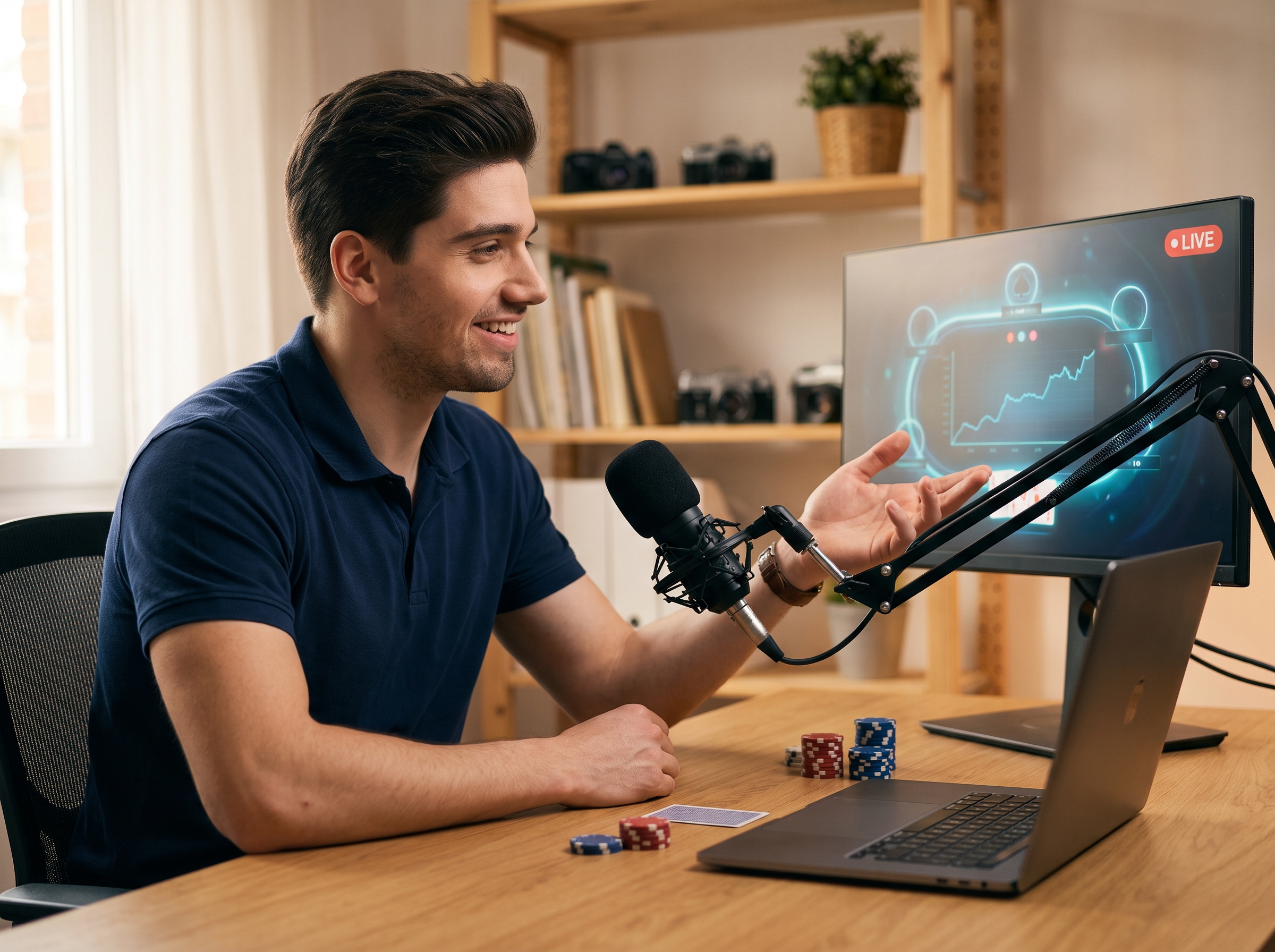
You’ve done the research. You’ve picked a creator from one of the platforms we covered in our guide to micro-influencers in iGaming - Twitch, TikTok, YouTube Shorts, wherever your players already watch. The creator wants $3,000 a stream. They want “exclusive” rights. And you’re about to sign.
That’s the moment an iGaming influencer marketing deal either pays for itself - or quietly bleeds for months.
This guide is the iGaming influencer marketing affiliate’s version of that question: not which platform to post on, but what the creator actually costs, what the contract should say, and what “exclusive” is worth.
The business side of creator deals
Influencers are no longer a feel-good media buy - they’re an acquisition channel with real economics behind it. Track360’s 2026 data puts affiliates at an estimated 38% of new regulated-market depositors, up from 34% two years earlier. iGB Affiliate even built a session around it at its 2026 Barcelona event - Influencers and Streamers: How Can We Do Better Here? - where the short version was “regulatory overhauls” meeting a creator economy still working through its growing pains.
The problem for you is that most published rate data on this topic is written for operators. Almost none of it tells the affiliate how to hire a creator. That’s where this guide comes in - rates, deal structures, contract clauses, exclusivity economics, and the fraud audit, all from your side of the table.
iGaming influencer rates 2026: what creators actually charge
First, a distinction that keeps getting blurred - the line between influencer marketing and affiliate marketing in iGaming. An influencer vs affiliate iGaming deal is two relationships with two different cost curves. In a classic affiliate deal you hand the creator your link and a code, pay nothing upfront, and own the channel until you deactivate it. In a creator deal you buy attention before it converts - flat fee, usage rights, maybe exclusivity - and the audience is still theirs. They just rented it to you for a while.
So what do iGaming influencer rates 2026 benchmarks actually say?
Mid-size Kick casino streamers run $500–$5,000 per stream, with top creators quoting $10,000–$50,000+ - and the gambling vertical pays a 2–5x premium over standard brand deals (LuvKaizen, 2026).
Mid-tier YouTube handicappers with 50K–200K subscribers charge $2,000–$6,000 per dedicated integration; sports-comedy podcasts run $5,000–$15,000 per 60-second top read (Influencer Advisory, 2026).
Gaming micro-influencers (10K–50K) average $120–$600 per sponsored Twitch integration (LaunchPoint HQ, 2026).
Always-on quarterly retainers discount 15–25% off spot rates (Influencer Advisory, 2026) - a creator you plan to keep costs less per unit the longer you hold them.
For example:
A 120K-subscriber mid-tier streamer quotes $4,000 for a dedicated casino stream. Your first instinct is to compare that to the $371 paid-social CAC the DraftKings program data shows (Influencer Advisory, 2026). Don’t. If that stream drives 60 first deposits, the fee is $66.67 per FTD - and you stack your commission against that number, not a media-buy benchmark.
A rate looks insane next to a CAC and reasonable next to a conversion. That comparison is the whole game.
KOL commission structure: why hybrid won in 2026
There are four deal shapes on the table: flat sponsorship, CPA, revenue share, and hybrid - a reduced flat fee stacked with a CPA or rev share leg. Which one gets signed? Per Track360’s State of iGaming Affiliate Marketing 2026, hybrid deals reached an estimated 41% of newly signed iGaming affiliate contracts in 2026, overtaking pure RevShare (33%) for the first time. Pure CPA sits at 26%.
Why the shift? Flat-only is a media buy - it costs the same whether the audience converts or not. Pure rev share pays the creator nothing until players deposit, a hard sell to someone who bills for content. Hybrid splits the risk: the creator gets a floor, you keep the upside.
The numbers behind it: average regulated-market CPA hit $145 in 2026, up 12% year over year, with UK and Nordics casino traffic running $250–$450 per deposit (Track360). Median RevShare on new contracts is 30% of NGR, with the middle 50% of deals at 25–35%.
(Still mixing up net and gross? We broke the difference down in our NGR vs GGR guide - it matters because the rev share leg is quoted against one or the other.)
For example:
A 90-day streamer program drives 200 FTDs and $300,000 in NGR over the first quarter.
Pure 30% rev share: $90,000.
Hybrid at $60 CPA plus 20% rev share: $12,000 + $60,000 = $72,000.
On a great month, pure rev share costs $18,000 more. On a bad one - 50 FTDs, $75,000 NGR - the hybrid costs $18,000 instead of $22,500, and the creator still gets a $3,000 floor. You’re not optimizing for the best month. You’re optimizing for the relationship surviving a bad one.
The flat leg is insurance - and insurance has a price tag, which brings us to the contract.
The creator contract: six clauses that decide the deal
Every creator contract is a skeleton, and these six clauses are the ribs.
1. Term and deliverables. Named, countable - “three 10-minute dedicated streams plus four short-form clips per month,” not “content as agreed.”
2. Usage rights - and they cost extra. A 6-month social license runs 20–30% on top of the base fee; perpetual worldwide usage runs 50–100%; paid-media usage is a separate fee (InfluencerFee, 2026). If you want to boost the stream clip, that boost is priced.
3. Approval windows. Push for 24–48 hours on anything time-sensitive. Anything over 72 hours and your content ships stale.
4. Kill fees. If you breach, the pro-rated fee commonly lands at 50% of remaining campaign value, with 7–10 day cure periods (InfluencerMarketingHub, 2026).
5. Non-compete and cooling-off. Post-campaign non-competes of 3–6 months are the norm, with the exclusivity window running the campaign length plus 30–90 days. Three dimensions get negotiated: scope, duration, and - most importantly - who counts as a competitor. “Any casino” is a different lock than “the four operators on your shortlist.”
6. Attribution and deactivation. Promo code or postback defined upfront, historical conversion data requested before signature, and an immediate link-deactivation right on your side - the pre-sign checklist Bigbetty’s 2026 iGaming guide calls out alongside disclosure obligations.
Payment terms are less negotiated than you’d think: 50% upfront / 50% on delivery is the standard shape (InfluencerFee, 2026).
If you want the operator side of the same numbers, our guide to negotiating iGaming affiliate deals walks the rate cards and hybrid structures from their end of the table.
And a regulatory footnote: several European markets restrict influencer-led gambling promotion - Italy treats influencer gambling ads as promotional communications, and Lithuania bars hyperlinks from its regulated promotion (SOFTSWISS iGaming trends, 2026). Confirm the market the content will be shown in before you sign.
Exclusivity in a creator contract: what it should cost you
Every creator exclusivity contract starts as a line item that looks optional and ends as the most expensive part of the deal.
The market premium ladder, from InfluencerFee’s 2026 pricing guide: a 30-day category lock adds 20–35% on top of the content fee; 90-day category adds 50–75%; 6-month category adds 75–100%. Full exclusivity - the creator runs no gambling deals with anyone - runs +50–80% over 30 days and +100–175% over 90 days. That’s the important part: the premium is added on top of the content fee, not substituted for it.
Want a defensible number instead of a quote? The opportunity-cost method (same source): the creator’s average monthly income from the restricted category, times the months of exclusivity, times a 0.7–0.9 recovery factor - 0.80 standard. That’s what the lock is actually worth, and it’s your anchor in negotiation.
So what do you actually buy? Our position: buy category exclusivity, time-boxed, scoped to competitors that actually compete with you. Full exclusivity in iGaming is a luxury purchase - the creator who can’t touch any gambling brand for a quarter will tell you exactly what that costs. Two alternatives worth trading in instead:
Performance exclusivity. The creator wins your FTD leaderboard and earns the lock for the next period.
Post-term exclusivity. That’s the one that leaks. Per Legal Lens UK’s 2026 breakdown, it’s “frequently requested… and frequently given away for free” - the creator stops promoting you, but the contract still blocks them from your operators for months. If you’re not paying for that period, you’re not buying it.
For example:
A creator on $3,000 a month. A 90-day category lock at the 50–75% premium adds $1,500–$2,250. Worth it only if the category has three or more live competing deals you’re demonstrably losing. If you’re the only operator in their niche, the premium is buying theater.
Influencer fraud detection in iGaming: the 20-minute audit before you sign
Here’s the uncomfortable data. Per the World Federation of Advertisers’ 2026 survey of 1,400 professionals across 28 countries, 81% encountered influencer fraud in 2026 - up from 74% in 2025 - with a median budget waste of $128,000 on a mid-scale affected campaign. And in iGaming you’re already being vetted by everyone else: Track360 estimates 14% of affiliate-referred signups triggered automated fraud review in 2026. Do the check before you sign, and you’ll filter the cheap way.
The taxonomy is short - fake followers, bot engagement, purchased views, engagement pods - and fake followers dominate: 56.5% of all reported fraud and quality issues in the Influencer Marketing Hub’s 2026 benchmark report.
The manual audit takes about 20 minutes per creator. Five signals, all eyeballable:
Engagement rate vs tier. Benchmarks sit at 0.5–1.5% for top-tier down to 4–6% for tier four (Influencer Advisory, 2026). More than 50% off the tier median is a flag.
Growth bursts. A 10–30% follower jump within a week, twice in six months, is a strong signal.
Audience region mismatch. Top regions more than 20 percentage points off the media kit.
Comment quality. Over 15% generic or emoji-only comments, or comment volume under 0.5% of likes.
View volatility. One post running 5–10x the creator’s trimmed mean.
Two or three flags - or one flag on a number you’d be paying a premium for - and you walk. If the numbers don’t survive the audit, the rate is wrong, not just high.
At Paynura
None of this is theoretical for us - creator deals are one of the traffic sources running through the network every day.
At Paynura, we help affiliates run that mix from one place: tracked links and promo codes on every creator, the same deal across casino, poker, and sportsbook offers, and conversions you can audit line by line. The guides on our news hub are the map; this piece is the money side of it.
Frequently asked questions
What’s the difference between influencer marketing and affiliate marketing in iGaming?
In affiliate marketing you give a creator your link and pay only on performance - the channel is yours and ends when the link deactivates. In an influencer deal you pay a fee for attention upfront, plus usage rights and sometimes exclusivity, and the audience stays the creator’s.
Should you pay a gambling streamer flat, CPA, or rev share?
Hybrid: a reduced flat fee plus a CPA or rev share leg. Per Track360’s 2026 report, hybrid reached 41% of newly signed iGaming affiliate contracts, ahead of pure RevShare at 33% and pure CPA at 26%.
How do you check if an iGaming influencer’s followers are real?
Run the 20-minute audit: engagement rate against tier benchmarks, weekly growth bursts of 10–30%, regions more than 20 points off the media kit, over 15% generic comments, posts running 5–10x average views. Two or three flags means walk.
Turn Creator Deals Into Real Affiliate Revenue
You already know where the creators are - the 5-platforms listicle covered the map. Now price them like the traffic source they are: vet the audience first, structure the KOL commission as hybrid second, and buy scoped category exclusivity - not full, not free - third. That’s what makes an iGaming influencer marketing affiliate deal a channel instead of a media buy with a personality.
Join Paynura today and track every creator deal - links, codes, and conversions - from one dashboard >>
Let’s talk: @paynura on Telegram. We reply within one business day.