

Binance has suspended its affiliate and referral programme for EEA users until further notice, creating an immediate traffic and revenue issue for crypto affiliates targeting Europe.
In a notice sent to affiliates, Binance said referral links had been disabled for EEA users and that commissions can no longer be earned from EEA referrals. Binance’s public referral terms also state that users registered in EEA countries became ineligible to participate in the referral programme from 1 July 2026.
For a crypto affiliate, the next task is clear: find where Binance is being promoted to EEA audiences, remove or restrict affected campaigns, and decide how that traffic should be monetised next.
Key takeaways for affiliates
Binance referrals for users registered in the EEA are no longer eligible from 1 July 2026, and Binance currently lists EU and EEA countries as restricted for its affiliate programme.
Affiliates should stop sending EEA users through Binance referral campaigns and review old links, referral codes, comparison pages, videos, newsletters and social content that may still attract European traffic.
The restriction applies based on the audience being targeted, not only where the affiliate is based. Affiliates outside Europe can still be affected if their campaigns target EEA residents.
MiCA itself does not ban crypto affiliate marketing. The Binance restriction is linked to the company’s current regulatory and licensing position in the EEA.
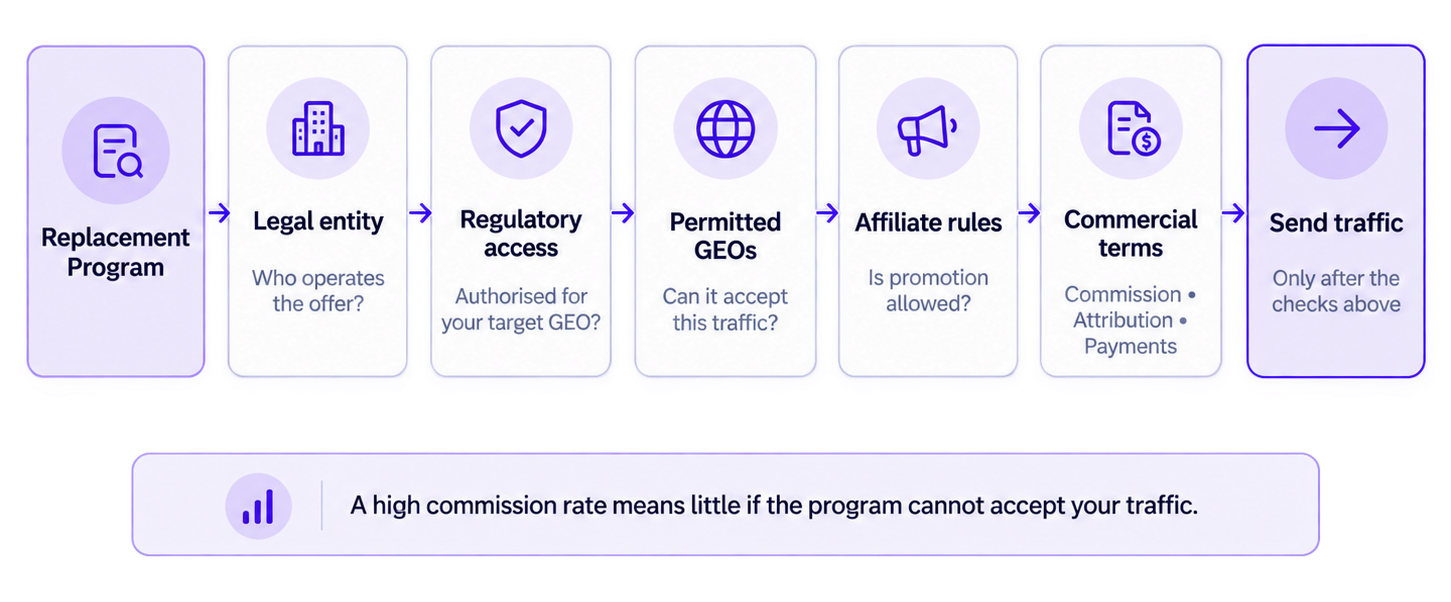
Before moving EEA traffic to another crypto affiliate program, check its regulatory authorisation, permitted GEOs, marketing rules, commission terms and tracking rather than choosing a replacement based only on the headline commission rate.
Affiliates relying heavily on one crypto program should consider spreading suitable traffic across several programs or related verticals to reduce the impact of future GEO or program changes.
What Binance Changed for EEA Affiliates
Binance now lists all EU and EEA member states among the restricted countries for its affiliate programme. Affiliates can review the current rules in the Binance Affiliate Program Restricted Countries Guide.
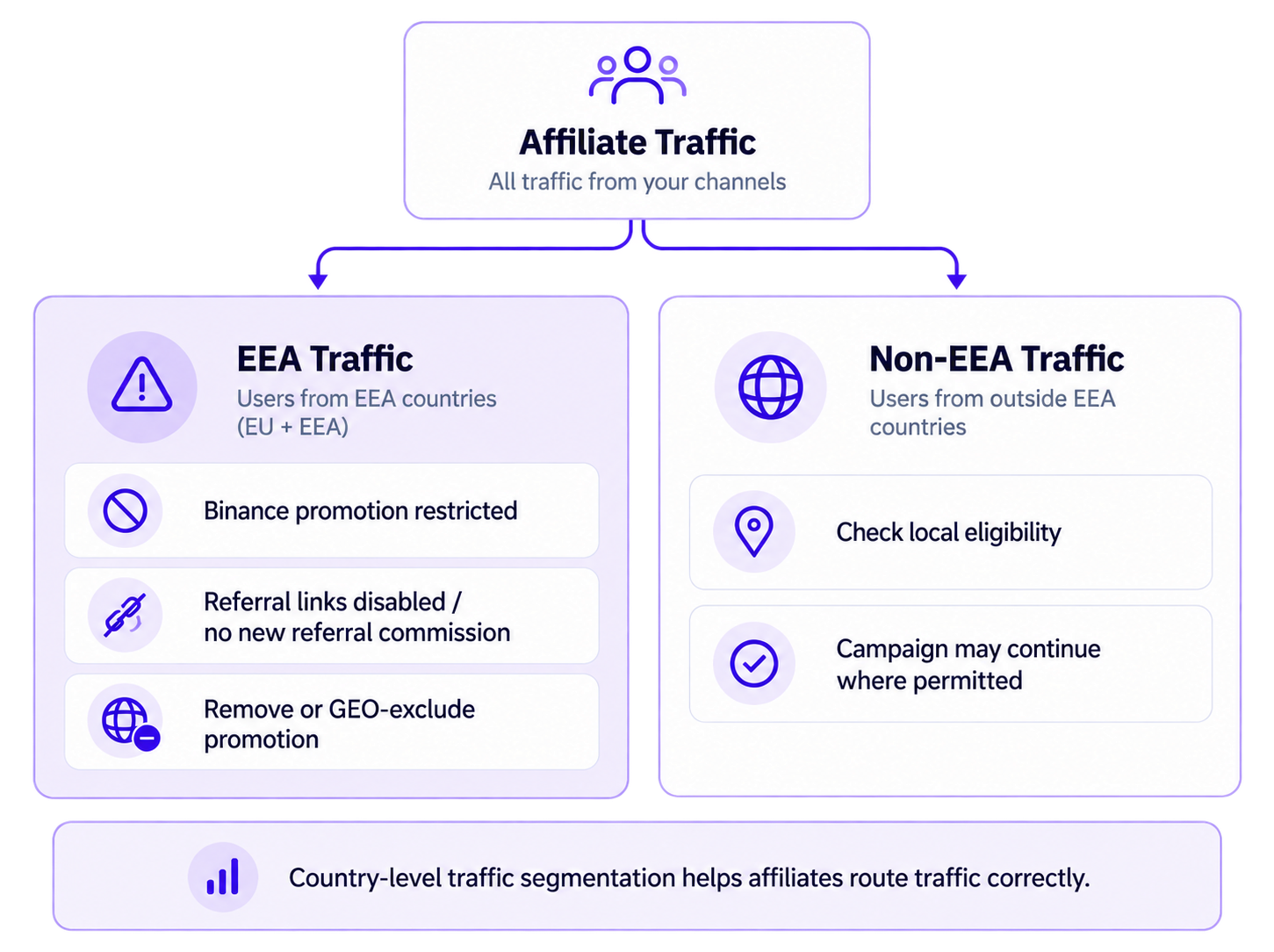
Its current affiliate rules prohibit marketing intended to encourage people in those markets to open an account, trade or purchase Binance products. The restrictions cover paid placements, promotional articles and videos, referral links, sign-up incentives, direct outreach and community promotion.
The audience being targeted matters more than the affiliate’s own location. A crypto affiliate based outside Europe can still fall under the restriction when its content or campaigns target EEA residents.
Binance also tells affiliates to use GEO targeting tools where available to exclude restricted countries from Binance-related promotion.
That makes country-level traffic segmentation a practical requirement for publishers with mixed international audiences.
Why MiCA Matters
The change is tied to Binance’s European licensing position under the Markets in Crypto-Assets Regulation, or MiCA.
MiCA requires firms providing covered crypto-asset services in the EU to have the required authorisation or operate through another route permitted by the regulation. Transitional arrangements allowed qualifying providers already operating under national rules to continue until 1 July 2026 at the latest, unless authorisation was granted or refused sooner.
Binance confirmed that it withdrew its MiCA licence application in Greece in June and said it planned to seek authorisation in another EU member state. The affiliate notice sent to partners states that Binance does not currently hold a MiCA licence to provide crypto-asset services in the EEA and does not want affiliates actively soliciting or targeting EEA residents.
The affiliate restriction is Binance’s response to its current licensing position. MiCA itself does not create a blanket ban on crypto affiliate marketing.
For crypto affiliates, the commercial lesson is simple: a crypto affiliate program should be checked both for its commission terms and for its legal ability to accept and market to traffic from the intended GEO.
What the Change Means for Traffic and Commissions
Change | Effect on EEA affiliates | Practical response |
|---|---|---|
EEA referrals suspended | New EEA referrals cannot generate Binance referral commission | Stop sending EEA users through Binance referral campaigns |
Referral links disabled for EEA users | Existing links may no longer monetise European traffic | Audit links and calls to action |
EEA-targeted promotion restricted | Paid, social, email and content campaigns can fall within the restriction | Remove or exclude EEA targeting |
Binance does not currently hold the relevant MiCA authorisation | European access depends on its regulatory status | Follow official licensing updates |
Revenue depends heavily on one crypto affiliate program | One regulatory change can remove a major revenue stream | Spread traffic across suitable programs and verticals |
For publishers buying traffic, the commercial effect can appear quickly. Paying for clicks that can no longer generate referral commission turns a previously monetised GEO into wasted acquisition spend.
SEO publishers face another problem. Old comparison pages, reviews and guides can keep attracting EEA visitors long after the original campaign was published.
Audit Existing Binance Content
Affiliates should review more than active ad campaigns.
Check Binance affiliate links and referral codes across older articles, landing pages, comparison tables, banners, newsletters, YouTube descriptions, social profiles, Telegram or Discord communities and automated email sequences.
Local-language content deserves close review. Binance identifies language, location, domains and other geographic signals as possible evidence that content is aimed at a restricted market.
English-language content is not automatically exempt. If a page, campaign or audience is aimed at an EEA market, using English does not change the targeting.
Affiliates with global traffic should also review GEO controls. A campaign that remains permitted in one country should not automatically remain visible to visitors from restricted markets.
Paynura’s GEO guide explains how restricted markets affect affiliate eligibility, conversions and commissions and can help publishers structure campaigns by country instead of treating all traffic the same way.
Check the Next Crypto Affiliate Program Before Moving Traffic
Replacing every Binance referral link with another exchange may fix a short-term monetisation gap, but it can recreate the same dependency if the replacement has not been properly checked.
Before sending EEA traffic to another crypto affiliate program, affiliates should verify the legal entity behind the offer, its current authorisation, the countries covered by that authorisation and the program’s own marketing rules.
Commercial terms deserve the same scrutiny. Check how commissions are calculated, which customer activity qualifies, whether existing users can be referred, how attribution works, which countries are excluded and how payments are handled.
A high commission percentage has little commercial value if the program cannot accept the traffic you are sending.
The same review process applies to adjacent finance verticals. Paynura’s guide to checking affiliate licences and payout terms gives affiliates a practical framework for reviewing the legal entity, regulator, tracking and commercial conditions before committing traffic.
Diversifying Beyond One Crypto Affiliate Program
The Binance change also exposes the risk of depending too heavily on one brand.
A crypto affiliate that relies on one exchange for most European revenue can lose a large part of its monetisation route when program terms or market access change. Using several suitable programs gives the publisher more options when one partnership stops accepting a GEO.
That does not mean sending crypto traffic into unrelated products. Audience fit still comes first.
Crypto, trading and fintech audiences can overlap with users interested in eWallets and other financial products. Skrill and Neteller, for instance, are used across trading, forex and iGaming audiences and can give suitable publishers another affiliate route.
For affiliates in the EU looking for a reliable affiliate network platform, Paynura provides access to multiple affiliate verticals from one network, including eWallet, casino, sportsbook and poker opportunities. Affiliates can manage multiple campaigns with centralized tracking and dedicated affiliate support rather than relying on a single crypto affiliate program.
Paynura is not a direct substitute for every crypto exchange affiliate program. Its role here is broader: helping affiliates discover other opportunities that fit their traffic, audience and GEO.
What Crypto Affiliates Should Do Next
Map your Binance exposure. Find every page, campaign and traffic source currently sending users to Binance.
Separate EEA traffic from other markets. Apply GEO exclusions where your publishing or advertising setup supports them.
Remove restricted EEA promotion. Review referral links, signup codes, incentives, branded content and old campaign material.
Verify any replacement program. Check authorisation, legal entity, GEO rules, commission terms and tracking before redirecting traffic.
Reduce dependence on one program. Test suitable crypto, fintech, eWallet or other affiliate opportunities based on audience fit.
Paynura can give affiliates a single place to review several affiliate verticals when a major program changes its market access, while a dedicated affiliate manager can help assess which offers fit the traffic being displaced.
Explore Paynura affiliate opportunities and speak with an affiliate manager about offers suited to your audience and GEO.
FAQ
Is the Binance Affiliate Program available for EEA users in 2026?
Binance’s public referral terms state that from 1 July 2026, users registered in EEA countries are no longer eligible to participate in the Binance Referral Program. Its Affiliate Restricted Countries Guide also lists all EU and EEA member states as restricted countries.
Can crypto affiliates still earn Binance commissions from EEA referrals?
The Binance affiliate notice says referral links have been disabled for EEA users and that commissions can no longer be earned from EEA referrals. Affiliates should also review account-specific communications and the latest program terms.
Does the Binance restriction affect affiliates outside Europe?
Yes, when their promotion targets EEA residents. Binance’s affiliate rules focus on where the target audience is located rather than only where the affiliate operates from.
What should I check before joining another crypto affiliate program?
Check the legal entity, current regulatory authorisation, permitted GEOs, affiliate marketing rules, commission calculation, attribution, payout conditions and tracking. For EEA campaigns, confirm regulatory access before sending traffic.