

An EU court ruling could affect how YouTube handles gambling content linked to commercial creator partnerships.
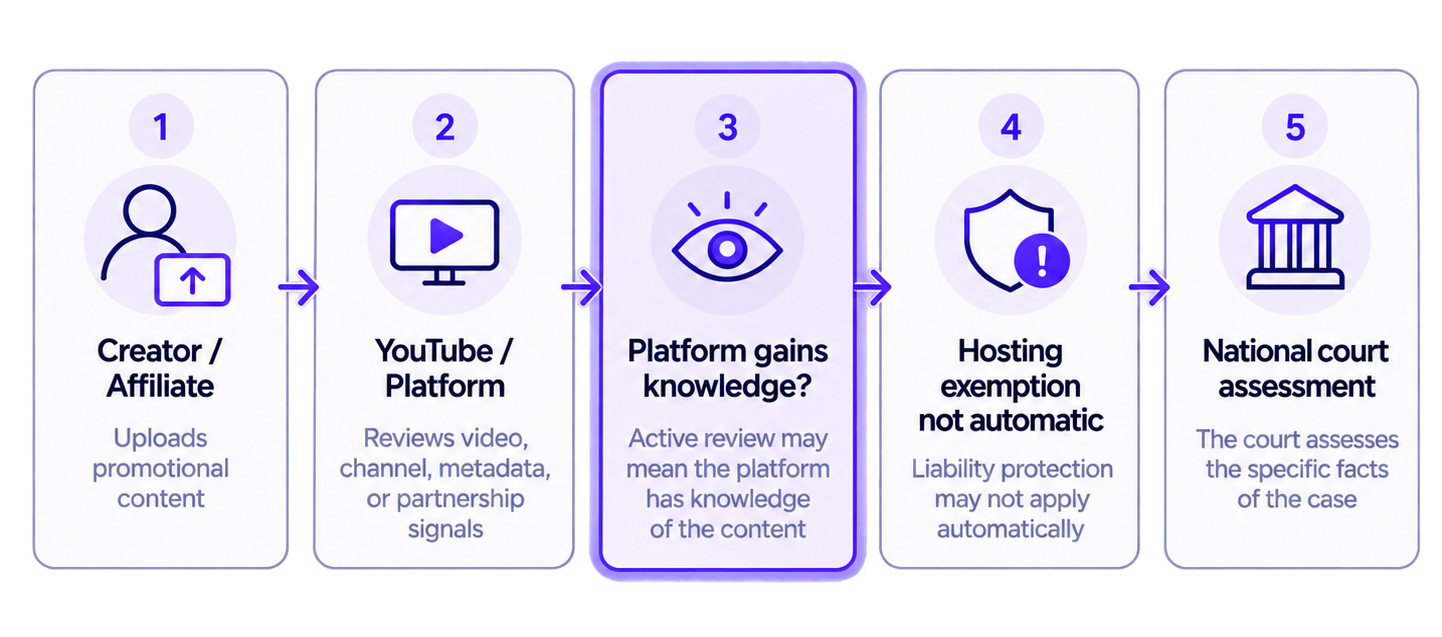
On 16 July 2026, the Court of Justice of the European Union ruled that when a platform reviews a creator’s content for a commercial partnership, that review can affect the platform’s protection from liability. The Court’s explanation sets out the distinction.
For gambling affiliates, the practical question is whether a YouTube campaign can keep bringing in referrals that are both permitted and payable.
At Paynura, affiliates can access casino, sportsbook and poker deals with account-manager support. This gives you someone to discuss offer selection and commercial questions with before you launch a campaign.
Key takeaways for affiliates
The ruling does not ban gambling content on YouTube or automatically change affiliate commission agreements.
YouTube may lose some liability protection when it actively reviews creator content as part of a commercial partnership. The Italian court still has to decide whether Google is liable in this case.
Affiliates should check three separate areas before promoting gambling content: local advertising rules, YouTube content policies and paid advertising requirements.
A restriction or removal can affect traffic, FTDs and future commissions, but what remains payable depends on the affiliate agreement.
Before launching a campaign, confirm the target GEO, traffic eligibility, content format and commission terms with the operator or affiliate manager.
What the court decided
The case started in July 2022, when Italy’s communications regulator, AGCOM, fined Google Ireland €750,000 over gambling promotions on YouTube.
Google argued that users had uploaded the videos, so it should not be responsible.
The EU court said YouTube may lose that protection if it reviews a creator’s content as part of a partnership that shares advertising revenue. The Italian court still has to decide whether Google is liable in this case. CJEU case summary
For affiliates, this could mean stricter checks on gambling content and creator partnerships. The ruling itself does not introduce new YouTube rules.
Three checks for gambling affiliate marketing on YouTube
If you use YouTube for gambling affiliate traffic, check three things separately: national advertising rules, YouTube content rules and paid advertising requirements.
Approval in one area does not automatically cover the others.
Review area | What to check | Suggested review owner |
|---|---|---|
National law | Whether the operator, product and promotional format are permitted for the intended market | Affiliate and operator compliance teams, with local advice where needed |
YouTube content | Whether the video and its destinations meet current content policies | Creator and campaign manager |
Paid advertising | Country eligibility, certification and destination requirements if buying ads | Advertiser or media buyer |
YouTube’s regulated goods policy prohibits directing viewers to uncertified gambling sites and promising guaranteed gambling returns.
The rules cover videos, descriptions, comments, livestreams and external directions, including spoken references.
Online gambling content can also be age-restricted, including content involving certified sites. The policy has limited exceptions for certain sports-betting content. Check the exact format and circumstances before relying on an exception.
Paid advertising needs a separate check. Google Ads has separate gambling requirements, including eligible countries, certification, responsible-gambling information and restrictions on targeting minors.
Approval of an organic YouTube video does not also approve a paid campaign.
Where campaigns and commissions could be affected
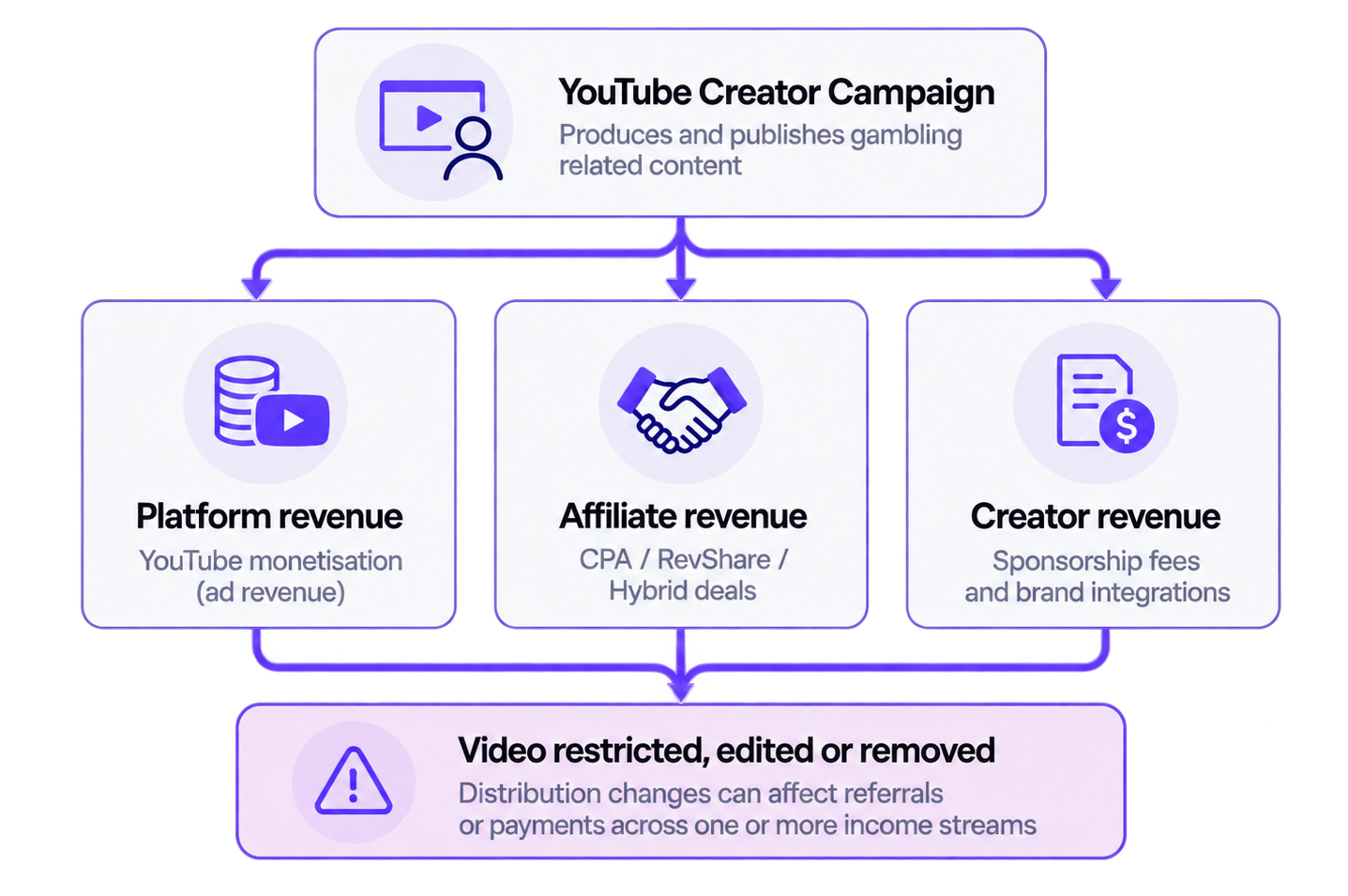
A gambling YouTube channel may earn money from three sources: platform advertising revenue, operator affiliate commissions and sponsorship fees.
Each comes from a different commercial relationship.
Check the agreement behind each income stream before spending money on production. If distribution is interrupted, referrals and first-time depositors could fall while production costs have already been incurred.
That is a risk scenario, not a measured consequence of this judgment.
CPA: Check which traffic sources are permitted, what qualifies for payment and how disputed referrals are validated.
RevShare: Check how losing new-player acquisition differs from your contractual rights over players you already referred.
Hybrid: Check the CPA and revenue-share parts separately.
Creator fees: Agree what happens to payment if an integration is cancelled, removed or needs to be replaced.
Before launch, ask your Paynura account manager about traffic eligibility, validation and continuing commissions for the specific offer. Ask for answers based on that program’s terms.
A removed video does not automatically decide what is payable.
Our guide to iGaming influencer contracts gives more context for structuring creator relationships.
What to check before your next promotion
Use the ruling as a reason to document your campaign decisions.
These are recommended operating checks. They are not new obligations imposed on affiliates by the Court.
Map the intended audience. Record your target countries and check available audience-location data. Language alone does not prove where viewers are located.
Confirm offer eligibility. Ask the operator to confirm in writing that the product, market and YouTube traffic are permitted. Keep legal and platform checks alongside that approval.
Review the full promotion. Check the spoken script, on-screen content, description, pinned comments and destination links. Also check older videos that still send traffic.
Decide who handles changes. Know who approves content, requests edits, pauses a campaign and deactivates links. Agree how urgent requests will reach the creator.
Check the payment terms. Look at traffic validation, withheld payments, termination and continuing commissions. Also check what happens to completed work and replacement content.
Keep records and monitor referrals. Save approved versions and dated checks. After an edit or removal, compare affected clicks and qualifying referrals with the affiliate manager.
Consider a hypothetical poker review whose linked offer changes its market availability.
Tell your affiliate manager about the change and ask about the existing deal and any alternatives. Review both the destination and the promotion, make any necessary pause or edit, and record the change.
Changing the link alone may still leave claims in the video unsuitable. Commission treatment must still be checked against the actual contract.
What to watch next
Watch the Italian proceedings, official YouTube policy updates and notices from operator partners.
YouTube could introduce tighter reviews or revised creator terms. The sources reviewed for this article, though, do not establish a platform-wide change caused by the ruling.
No later Italian merits decision was verified for this update.
Questions from gambling affiliates
Does the ruling automatically cancel affiliate commissions?
No. It does not rewrite operator affiliate agreements.
Check the contract’s traffic, payment and termination terms before deciding what happens to a particular referral.
Would leaving the YouTube Partner Program make a promotion compliant?
No. A creator still needs to follow applicable advertising law and YouTube content rules.
Monetisation status is only one part of the check.
Does Google certification make promotion legal across Europe?
No. Certification is a platform requirement.
National advertising permissions and product restrictions still need to be checked for each intended market.
Talk to Paynura about your YouTube traffic. Share your target markets and content format so the conversation starts with the offers and conditions relevant to your plans.