
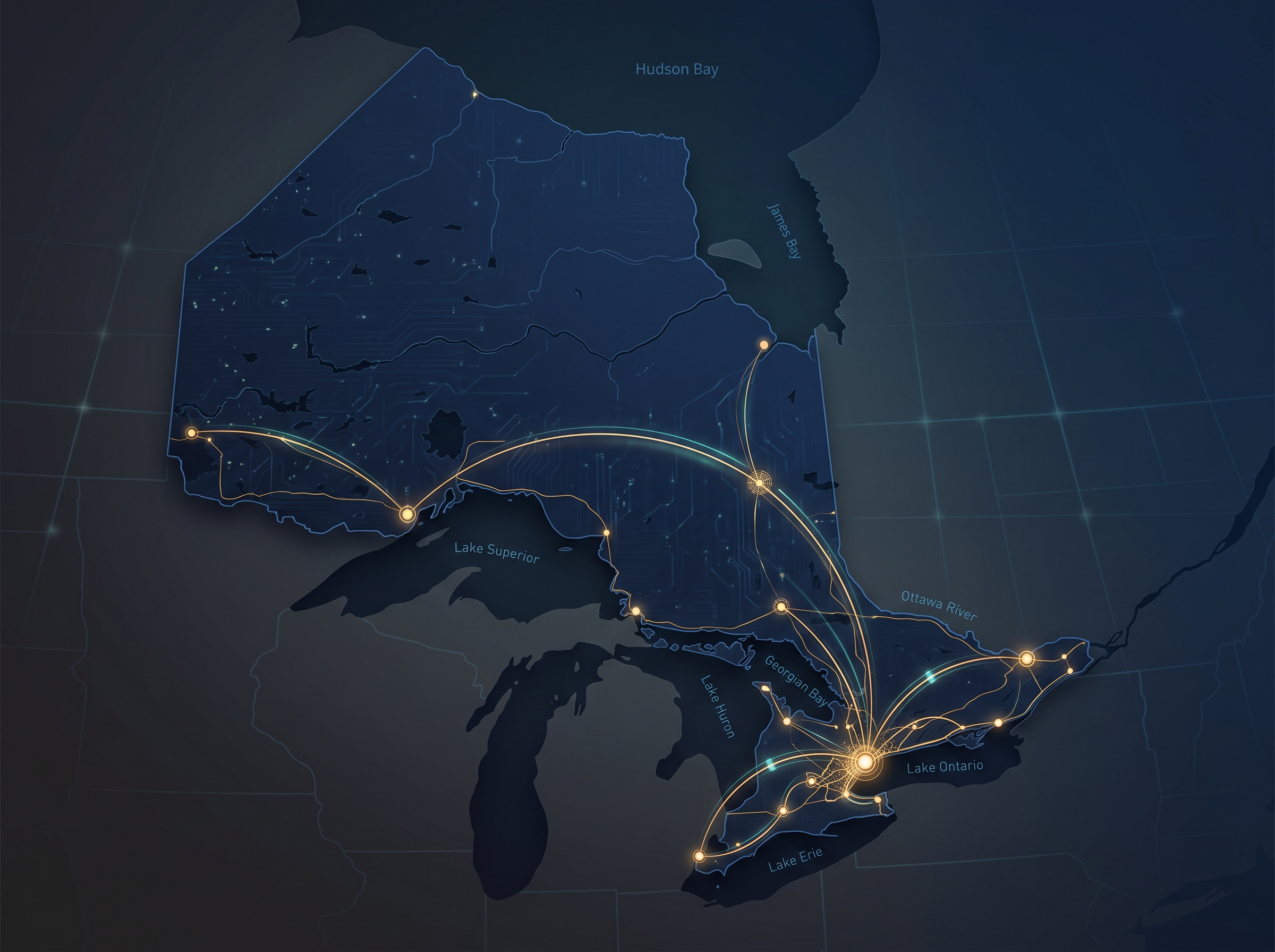
Stylized digital map of Ontario with glowing network connection nodes radiating outward
Every affiliate knows the playbook. Find the biggest welcome bonus, build a comparison page, rank for “[brand] bonus code,” collect CPA. It’s worked from the UK to New Jersey to Brazil.
But there’s a regulated market doing CA$9.5 billion a month in handle where that playbook is flat-out illegal. And the regulator actually enforces it.
Ontario. Forty-eight operators. Eighty-two gaming sites. Over four hundred million a month in gross gaming revenue. And exactly zero public-facing bonuses, anywhere.
That’s where this guide comes in. Ontario’s advertising rules don’t just change what affiliates can say - they change what kind of affiliate business actually works. And for the ones who get it right, that’s a competitive moat, not a limitation. In this guide, we’ll walk through the regulatory structure, the content formats that win without bonuses, the economics that actually pencil out, and how to position yourself as the affiliate operators want on their team.
Last updated: August 2026
The two-body system - AGCO, iGaming Ontario, and why the distinction matters for affiliates
If you’ve worked regulated markets before, you’re used to a single regulator calling the shots. Ontario does it differently - and the split matters.
When Ontario launched its competitive iGaming market on April 4, 2022, it created a two-body system. The Alcohol and Gaming Commission of Ontario (AGCO) is the regulator and enforcer - it writes the rules, investigates breaches, issues fines. iGaming Ontario (iGO) is the commercial conductor - it signs operating agreements with operators, manages day-to-day market operations, and collects the revenue-share contribution that funds the province.
Why does the distinction matter for affiliates? Because AGCO enforces the rules you have to follow, and iGO’s contribution rate shapes the commissions operators can afford to pay you.
The AGCO sets and enforces the Registrar’s Standards for Internet Gaming. These standards cover everything from game integrity to advertising - and in April 2024, the AGCO added amendments that directly affect what you can publish. iGO, meanwhile, became an independent Crown agency in May 2025, operating at arm’s length from the government. It doesn’t regulate affiliates directly, but its revenue-share contribution - effectively around 20% of gaming revenue, according to public reporting cited by Track360’s Ontario operator guide - is a line item every operator deducts before calculating your commission pool.
The whole system was enabled federally by Bill C-218 in 2021, which decriminalized single-event sports betting and left regulation to the provinces. Ontario chose an open, competitive model - the only province to do so. Every other province still runs a government monopoly.
Four years in, the market is mature: 48 operators, 82 gaming websites, and a regulatory apparatus that’s proven willing to enforce. Understanding who does what isn’t academic - it’s the foundation for every content decision you’ll make.
The inducement ban - what Standard 2.05 actually says and what it means for your content
Here’s the rule that changes everything for affiliates: AGCO Standard 2.05.
In plain language: no bonuses, credits, free bets, cashback, or any other inducement in any public-facing advertising. Not on your website. Not in your social posts. Not in a display ad. Not in a push notification. It’s a near-total public ban, and it applies to you because the operator is responsible for everything their affiliates publish.
Where are inducements actually allowed? Two places only. First, on the operator’s own gaming site or app - visible only to players who are already there and have consented. Second, through direct marketing to players who actively opted in on that gaming site. Critically, this consent must come through the operator, not through your affiliate landing page. You can’t collect consent on a third-party site and pass it along.
Then came the 2024 amendments, which tightened things further. Active and retired athletes are banned from gambling advertising - the only exception is responsible-gambling messaging. Content that might appeal to minors got a major crackdown too: no cartoons, no influencers or entertainers likely to attract underage audiences, no imagery that blurs the line. And operators now face marketing restrictions aimed at high-risk players - meaning the compliance bar keeps rising.
On top of AGCO enforcement, the Ad Standards Canada Code took effect January 1, 2026 - adding a public-complaint mechanism anyone can trigger. So it’s not just the regulator watching. It’s competitors, advocacy groups, and the public.
This isn’t the UK model, where you can promote a bonus as long as you disclose the terms. It’s not the US state-by-state patchwork, where some states ban certain phrases and others don’t. Ontario’s ban is structural. The question isn’t “how do I phrase my bonus offer carefully” - it’s “what do I build when I can’t use bonuses at all.”
That’s the question the next two sections answer.
When affiliates get operators fined - the BetMGM case and why operator liability changes the game
Standard 1.19 is the rule that makes Ontarian operators genuinely care about what you publish. It says the operator is fully responsible for the conduct of its affiliates and marketing partners. Your breach is their breach.
And the AGCO doesn’t just write that rule - it enforces it.
In March 2025, the AGCO hit BetMGM Canada with C$110,000 in penalties after an affiliate called “Above the Street” ran a cash-inducement campaign: 377 sign-ups, C$127,180 in commissions paid. The operator was fined. The affiliate wasn’t - but here’s the part that matters for you. A second affiliate, “Maple Leaf Marketing,” was named in the same action: 94 sign-ups, roughly C$34,000 in commissions.
The AGCO’s official penalty notice made the operator-liability principle crystal clear.
Then in June 2026, the AGCO fined another operator C$220,000 for public welcome-bonus advertising. And these aren’t the first penalties either - as early as May 2022, BetMGM and PointsBet were fined C$48,000 and C$30,000 respectively. The enforcement history is consistent, not a one-off.
What does this mean for you as an affiliate? Operators now bake compliance requirements into their affiliate agreements: geo-restriction verification, creative pre-approval, audit trails, indemnity clauses. If you can demonstrate clean compliance infrastructure upfront - segmented reporting, no-inducement creative, jurisdiction-locked content - you get better deals. Faster approvals. Preferential positioning.
In most markets, affiliates chase operators. In Ontario, the dynamic flips. Operators chase affiliates who won’t get them fined. That’s a positioning advantage if you build for it.
The content formats that actually work - what replaces the bonus landing page
So if you can’t lead with a bonus, what do you lead with? Here’s what’s converting in Ontario right now - built from the formats that win in every no-bonus market.
Comparison and review content - anchored on what actually matters. Withdrawal speed. Game selection depth. Mobile UX quality. Customer support responsiveness. Trust signals: the AGCO registration badge, RG tools, operator track record. No “best bonus” lists. A side-by-side comparison of Interac payout times across five Ontario-licensed sportsbooks? That converts.
Payment-first trust content is the highest-converting block for Canadian players. Before they check odds, before they browse game lobbies, Canadian players check whether their payment method works. Interac e-Transfer. iDebit. Instadebit. MuchBetter. Crypto rails where available. Show realistic processing times and CAD pricing throughout. This answers the question players actually arrive with - and it’s fully compliant because it has nothing to do with bonuses.
Regulatory explainers, woven into every page. A short snippet on provincial legality, the AGCO’s player protections, what Ontario licensing means. This builds trust and reduces bounce - when a player sees you understand the rules, they assume the operators you recommend are legitimate. That’s exactly the signal Google’s E-E-A-T framework rewards.
Educational guides and tools. How to read odds. Sport-specific strategy guides for NHL, CFL, NBA. Live odds calculators. These drive time-on-page and return visits - the kind of content that builds domain authority over months, not weeks.
Seasonal content calendars mapped to Ontario’s year. NHL playoffs. World Juniors. CFL season kickoff. Stanley Cup finals. Boxing Day. Canada Day. These are predictable search spikes - plan content around them and you capture intent without competing on bonus keywords.
Social and community acquisition. TikTok and Instagram Reels for younger audiences. Twitch sponsorships with Canadian streamers. Reddit in Leafs Nation and CFL communities. Discord servers around betting strategy. These channels build audiences that convert on trust, not a promo code.
SEO specifics for Ontario. CAD-priced examples throughout. Geo-modified H-tags (“Ontario sports betting sites,” “Interac e-Transfer casinos Ontario”). FAQ schema answering provincial questions. Author bios with real credentials. First-hand testing evidence - screenshots of withdrawal confirmations, documented processing times, methodology transparency. These aren’t ranking hacks. They’re what E-E-A-T looks like when you actually earn it.
The common thread across every format: you’re building content that works because it’s useful, not because it’s promotional. In a market where the promotional playbook is illegal, useful is the only sustainable advantage. That’s the important part.
The money - revenue-share contribution, what it does to affiliate commissions, and what you should actually expect
Let’s talk numbers - because Ontario’s economics are different, and you need to model them honestly.
iGO collects roughly 20% of operator gaming revenue under its operating agreements. This isn’t technically a tax - it’s a contribution - but for margin math, it functions the same way. Operators pay iGO before calculating anything else, including your commission.
That 20% comes straight off the top. When an operator quotes you 35% RevShare, you’re getting 35% of what’s left after iGO takes its cut - not 35% of gross. Ontario RevShare of 20-40% of NGR behaves more like 15-25% of the GGR-equivalent pool you’d see in Curacao or Malta. The math isn’t complicated - it’s just compressed.
Here’s what the market actually pays. CPA deals range from C$400 to C$600 for premium, exclusive placements - stronger than most European markets on a per-player basis. RevShare runs 20-40% of NGR, with 25-35% being the realistic range for established affiliates. Hybrid structures - something like C$50 CPA plus 20% RevShare - are increasingly common for affiliates who can prove player quality. For a deeper explanation of how NGR deductions affect your commission math, we’ve broken down the full NGR vs GGR mechanics here.
One counterintuitive reality: RevShare often beats CPA in Ontario. Why? Because bonus-hunting traffic - the kind that signs up, claims a bonus, and disappears - is structurally weaker. There’s no public bonus to hunt. Players who sign up without a bonus incentive tend to deposit, play, and stay. Their lifetime value is more predictable. Quality beats quantity, and RevShare captures that quality over time.
Casino dominates the market - 78 to 88% of revenue across months, per iGaming Ontario’s quarterly reports. If you’re building an Ontario affiliate portfolio, casino content should get the bulk of your attention. Sports betting is the growth story, but casino is the revenue engine right now.
The market size puts the opportunity in perspective. May 2026 alone: CA$9.48 billion in handle, CA$413.1 million in net aggregate gaming revenue. H1 2026 online casino revenue hit CA$1.86 billion - up 30% year over year, according to data reported by Canadian Gaming Business and Global Gaming Insider. Roughly 1.3 million active player accounts, with average monthly spend around CA$228 and ARPU north of CA$300. This isn’t a niche.
But here’s the qualifier. The contribution rate isn’t going down, and operators are passing that cost through to affiliate terms. The days of 45% RevShare in Ontario are probably gone before they started. What’s left is solid, sustainable commission economics - good enough to build a business on, but not inflated by operator acquisition subsidies. That’s actually healthier for long-term affiliates. Bonus-inflated margins collapse when the bonuses get regulated out anyway.
If you’re negotiating operator deals, understanding how operator mergers affect your commission structure is worth the read - especially as the Ontario market consolidates.
At Paynura - your infrastructure for Ontario (and every regulated market that follows)
Here’s the pattern. Ontario in 2022. Brazil regulating in 2025. Peru tightening. The UK cracking down on bonus-led marketing. Every major regulated market is moving the same direction - toward compliance-first, content-first affiliation - and Track360’s Q3 2026 regulatory roundup tracks this tightening across every continent.
The playbook you build for Ontario isn’t a one-market workaround. It’s the model for every market that follows.
At Paynura, we work with 3,000+ registered affiliates, managing 145K+ tagged accounts and over $150M in annual deposit volume across casino, sportsbook, poker, and e-wallet verticals. Our operator partners include Ontario-licensed brands across every category - and we know what their compliance teams are asking for.
What we offer Ontario-focused affiliates: access to operator partners who are licensed and live in the province, a single dashboard that tracks performance across every vertical, flexible payouts that don’t make you wait for the monthly cycle, and account management that understands regulated-market compliance. We help you connect with operators who value compliant traffic - the kind that doesn’t get them fined.
If you’re building Ontario traffic - or want to be - let’s talk.
Join Paynura today and start building your Ontario affiliate portfolio.
We covered the Peru market playbook in a separate guide - and the same compliance-first approach that works from Brazil to Ontario is what separates sustainable affiliate businesses from the ones that peak with one bonus season.
Frequently Asked Questions
Do I need a license to be an affiliate in Ontario?
No separate affiliate license exists in Ontario. You operate under a registered operator’s affiliate program, and the operator carries the regulatory responsibility - including full liability for what you publish.
Can I promote Ontario sportsbooks from outside Canada?
Yes - there’s no residency requirement. You can promote Ontario-licensed operators from anywhere. Your content must still comply with AGCO advertising rules (no public inducements, no athlete imagery), and the players you send must be physically in Ontario and 19 or older.
Is Ontario the only regulated iGaming market in Canada?
Ontario is the only open, competitive market in Canada. Every other province runs a government monopoly: Loto-Quebec, BCLC’s PlayNow, Atlantic Lottery. Alberta has legislation moving toward an Ontario-style model - that’s the next potential opportunity. Until then, Canada-wide strategies have to be province-by-province.
What’s the minimum payout for Ontario affiliate commissions?
It varies by operator program. Expect thresholds in the C$50 to C$200 range, typically via wire, Skrill, or Neteller. Through Paynura, payouts are consolidated across operators so you’re not managing separate minimums per program.
If I can’t promote bonuses, what’s my actual hook?
Payment speed, game quality, mobile experience, and trust. Canadian players care about Interac availability more than bonus codes. Build content around withdrawal processing times, game selection depth, and licensing safety. That’s what converts when the bonus playbook is off the table.
How do I get started promoting Ontario operators on Paynura?
Apply through Paynura’s registration, and our team matches you with Ontario-licensed operator partners that fit your traffic profile. You’ll hear back within one business day. One dashboard, every vertical, compliant from day one.
Turn Ontario’s no-bonus market into your competitive advantage
Ontario’s rules don’t make affiliate marketing harder. They make it harder for the wrong kind of affiliate - the ones who only know how to rank a bonus code and collect CPA until the regulator catches up. The affiliates who build real content, real trust, and real compliance infrastructure get better deals and less competition.
That’s not a disadvantage. That’s a moat.
Join Paynura today and build your Ontario affiliate portfolio - one dashboard across casino, sportsbook, poker, and e-wallets, operator partners who value compliant traffic, and payouts that work the way you do.
Let’s talk: @paynura on Telegram.