

You send your best player to a brand mid-month. She wins $80,000 on the slots on the last day of the month, and your whole book goes quietly into the red. The player hit the jackpot. You just watched your next payout disappear.
And if your program runs on negative carryover, that red balance doesn't reset on the 1st. It rolls into the next month, and every dollar you earn first goes to paying it back. You're not the only one who has hit this. On the GPWA forum, webmasters recommend programs specifically because they run without negative carryover, and a thread on r/Affiliatemarketing about commission shaving in iGaming has affiliates checking statement lines they used to trust.
So what does the clause actually do to your cash flow, and what should you be negotiating before it bites?
By the end of this you'll be able to find NCO in a contract, run the month-by-month math on your own book, tell a clawback apart from carryover, and know which terms are worth pushing back on before you sign.
What negative carryover actually is
Negative carryover, usually shortened to NCO or called negative rollover, is a policy in iGaming affiliate programs where a negative commission balance from one accounting period carries forward to the next.
Most iGaming programs pay RevShare, a fixed percentage of the net gaming revenue your players generate. The revenue side is commonly calculated as NGR = GGR - Bonuses - Fees - Chargebacks, and your commission is NGR times the agreed rate, commonly somewhere between 20% and 50%. If a player's net contribution for the month goes negative, the same rate produces a negative commission. That's the whole mechanism. The carryover is just what happens next: instead of the month closing at zero, the deficit becomes the opening balance.
A month that ends at -$5,000 means the next month starts at -$5,000, not $0. Every commission you earn has to clear that gap first, before a single dollar reaches a payout.
If you're still deciding between RevShare, CPA and the rest, we've broken down how CPL and the other commission models work in this guide. NCO only bites when revenue is tied to player performance, which is exactly the RevShare setup.
The math: four months on a real book
This is the worked example the iGaming data platform Blask walks through, at a 40% RevShare rate. Four months, one bad player in month two.
| Month | NGR | Commission at 40% | Running balance | Paid out |
|---|---|---|---|---|
| January | +$10,000 | +$4,000 | +$4,000 | $4,000 |
| February | -$15,000 | -$6,000 | -$6,000 | $0 |
| March | +$8,000 | +$3,200 | -$2,800 | $0 |
| April | +$12,000 | +$4,800 | +$2,000 | $2,000 |
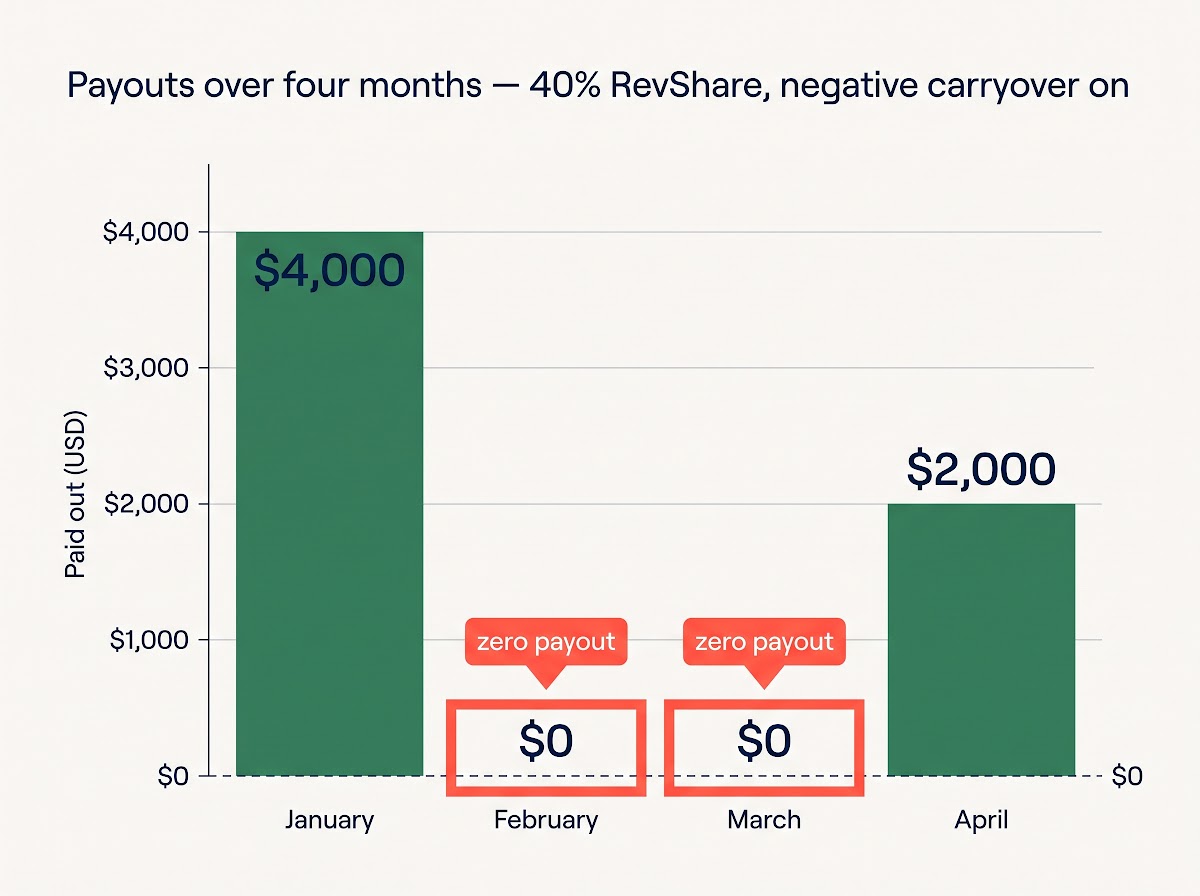
Payouts over four months, negative carryover on - the two zero-payout months
In March, NGR is positive, commission is positive, and the payout is still zero. March's $3,200 only clawed back part of the $6,000 deficit, leaving the balance at -$2,800, and April's $4,800 still only surfaced $2,000 in cash. Two consecutive zero-payout months on a book that was making money.
Scale it up and it gets worse fast. A single $80,000 slot win on the last day of the month drops a 40% book to a -$24,000 balance. That's a deficit that takes multiple green months to clear, no matter how the rest of the book performs.
And if the program bundles brands into one balance, the math compounds. Blask's bundled scenario: three brands reporting +$5,000, +$3,000 and -$12,000 net to -$4,000 for the month. No payout, even though two of the three brands were clearly in the green.
NCO vs NNCO: what the contract should say
The opposite setup is No Negative Carryover (NNCO). Under NNCO the balance resets to zero at the start of every new period, no matter how badly the previous month landed.
In practice, operators rarely hand that over for free. High-roller thresholds are commonly cited between $5,000 and $10,000: a player who wins past the threshold gets ring-fenced, the NCO applies to that single player only, and the rest of your book resets monthly. Programs advertising NNCO often offset the benefit with lower RevShare rates, stricter high-roller policies or extra administrative deductions. Read the rate and the deductions together, not the label alone.
There's a reason operators insist on some form of carryover. Blask's timing scenario makes the case. A player wins $50,000 on September 30 and the balance resets under NNCO. The same player loses the amount back on October 2, and the operator eats the entire swing with no offset. Some programs close that gap other ways, capping how long a deficit can roll or ring-fencing a single winning player instead of the whole book. Program directories now track NCO versus NNCO as a standard attribute, which tells you it's a line item, not a footnote.

NCO vs NNCO: whether the deficit carries forward or resets to zero each month
Clawback is not negative carryover
The confusion is common, and it matters. Negative carryover is a forward adjustment. It withholds future commissions until the deficit clears, and it doesn't take back anything. In most programs the money you've already been paid is safe, and the deficit never becomes a bill you settle out of your own pocket.
Clawback is a backward adjustment. When a player refund, chargeback or fraud case lands after monthly settlement, previously calculated commissions can be reversed, and some agreements include clawback provisions that reach recently paid commissions. So the clause that can touch money already in your account is the clawback, not the carryover. That's why the two deserve separate lines in your contract review.
What it does to your cash flow
The direct hit is the zero-payout stretch: months where NGR is positive and the payout is still $0, exactly like the March above. If your operation runs on RevShare, that's the line item that quietly re-prices your overhead.
The second hit is harder to see, because it lands on the same statement lines. That r/Affiliatemarketing thread about commission shaving in iGaming describes the practice in detail: campaigns assigned a 0% commission, tracking links that carry no commission, players moved from a higher-rate campaign to a lower one, and players vanishing from reports entirely. None of that is carryover. All of it shows up as a negative balance you can't immediately explain. So when a red month appears, pull the underlying players and campaign rates before you assume the clause is doing the work.
What to check before you sign
When a contract lands on your desk, pull out these five lines first.
The carryover clause itself. Does the balance reset at each period start (NNCO), or roll forward (NCO)?
The high-roller threshold and ring-fencing. Where is the cap, and does the deficit hit the whole book or a single player?
Bundling. Are brands reported separately, or netted into one balance where a losing brand swallows two green ones?
The clawback window. How far back do refunds, chargebacks and fraud adjustments reach?
Dispute resolution. Who recomputes a disputed month, and which report do you both sign off on?
If the answer to any of those is "we'll confirm later," that's the line to push back on. Negotiate ring-fencing for high rollers first. It protects your book without giving up the rate.
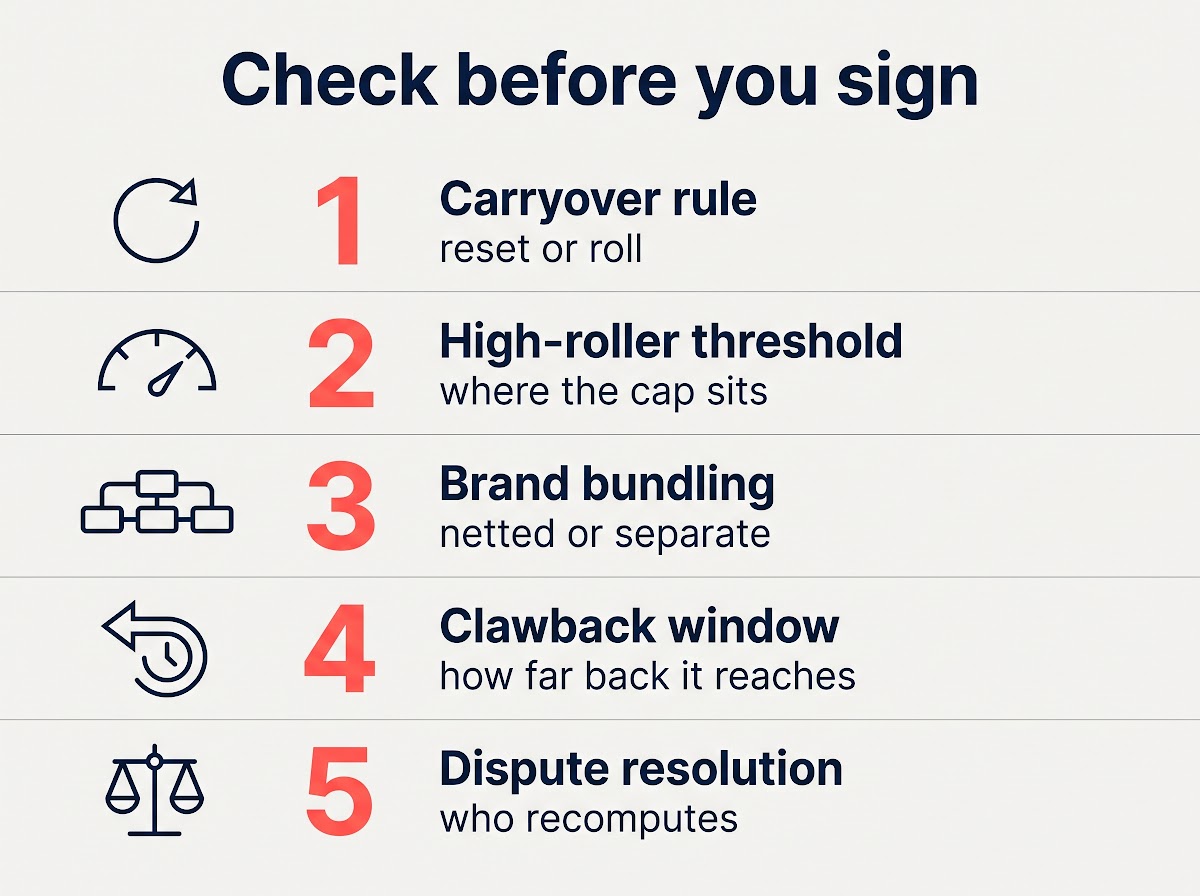
Five points to check in a negative carryover contract
At Paynura
We built Paynura as one partnership across eWallets, Poker, Sportsbook and Casino, so your traffic isn't spread across half a dozen different payout structures. The terms are fixed and visible: commissions are paid monthly based on the previous month's performance, and payments go out between the 5th and 10th of each month via Skrill, Neteller or crypto (BTC, ETH, USDT). You can read the payout terms before you apply, and the full offer lineup is one dashboard away.
If you're comparing programs right now, ask the negative carryover question before the rate question. You can apply here and see the structure before you sign anything.
Questions affiliates actually ask
Do I have to repay the deficit out of my own pocket?
Under a standard NCO clause, no. The deficit is deducted from future commissions until it clears. It doesn't become an invoice you settle from your own account, and in most programs the money you've already been paid stays with you.
Does negative carryover touch commissions I've already been paid?
Not by itself. NCO only withholds future earnings until the balance recovers. The clause that can reach paid commissions is the post-settlement clawback, which is why it deserves its own line in your contract review.
How common is negative carryover in iGaming?
Common enough that program directories track it as a standard attribute, and common enough that affiliates openly recommend programs that run without it. You'll see it in most RevShare contracts, often paired with a high-roller clause, so verify it in writing rather than assuming.
What should I look for in the contract?
The reset rule, NCO versus NNCO. The high-roller threshold and whether the deficit ring-fences a single player. How brands are netted. The clawback window. And a clear process for recomputing a disputed month.
The next contract you sign is the one worth reading
A green month with a hidden deficit in it isn't green. Before you sign the next RevShare, find the carryover line, run the math above on your own numbers, and make the clause work as hard for you as the rate does.
At Paynura, we help affiliates turn traffic into monthly revenue they can plan around, across eWallets, Poker, Sportsbook and Casino. Put the payout terms on the table first, and sign with the numbers in front of you. Apply here.