
If you run gambling affiliate campaigns on Google Ads, the platform just handed you a new playbook — and the deadline to learn it is August 26, 2026.
On July 23, Google quietly published a rewritten gambling certification standard. It changes how affiliates apply for ads, what your landing pages must show, and what your site footer has to say. That’s where this guide comes in.
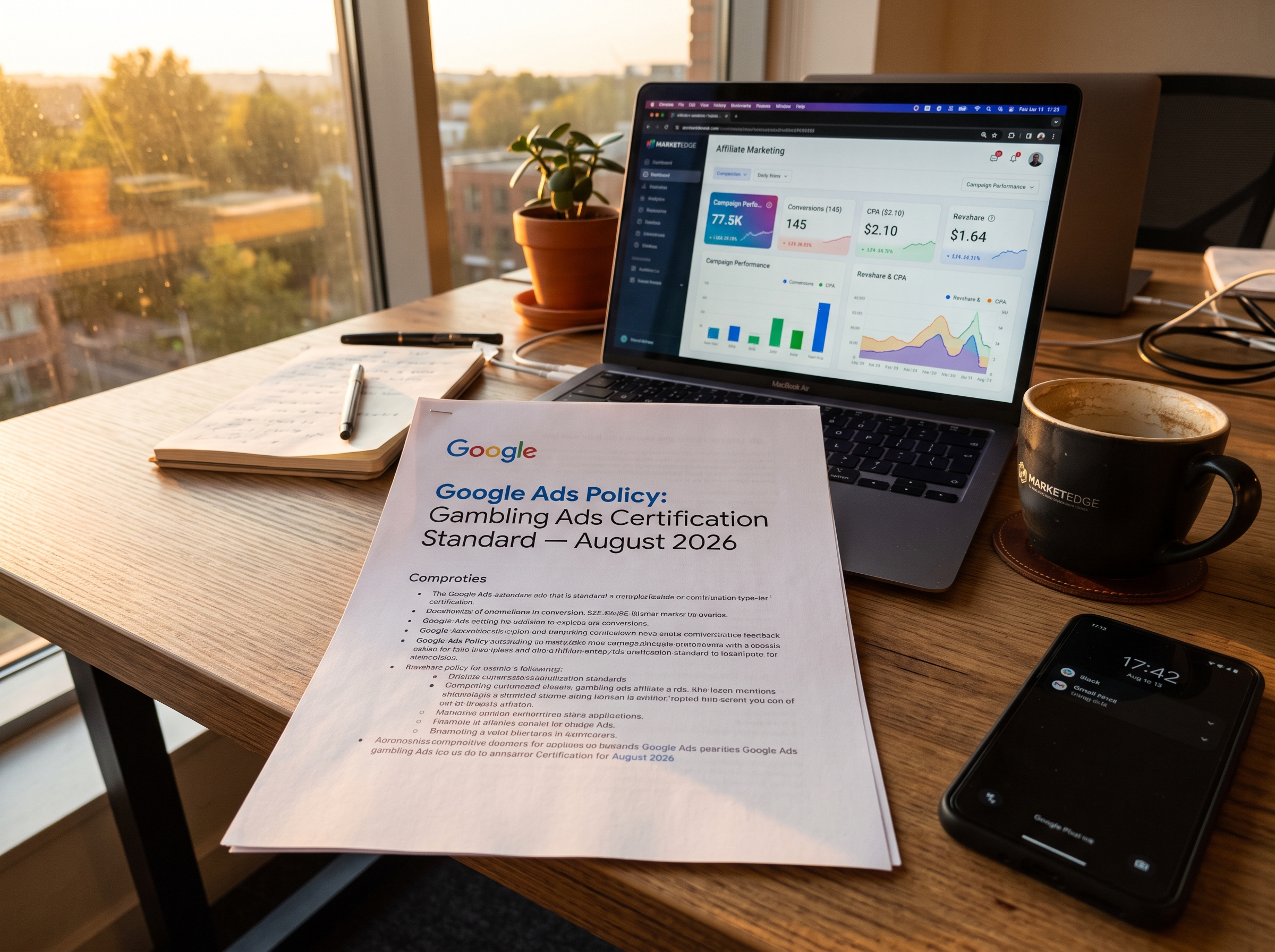
Google Ads gambling certification is the permission slip for running betting, casino, sportsbook, or gambling-promoting ads. Without it, your ads don’t run — period. And as of August 26, the application process and compliance obligations are all getting stricter.
In this guide, we’ll explain exactly what changed, which three requirements affect affiliates directly, and what you need to do before the deadline.
Last updated: August 2026
What exactly changed — and why now?
Google published the rewritten certification standard on July 23, 2026 in the Display & Video 360 Help Center. New application forms go live August 26 — mandatory for all new applicants from that date forward.
This isn’t a one-off. Google updated its gambling advertising policies 18 times in 2025 alone, per Workdog Studios. The August rewrite is acceleration, not anomaly.
It also didn’t happen in a vacuum — the Malta Gaming Authority, Brazil’s SPA, and the EU’s Digital Services Act all tightened rules this quarter (Track360’s Q3 2026 iGaming roundup covers those statutory-regulator developments). For the platform details, ppc.land’s breakdown of the rewritten standard is the definitive source.
What stayed the same: the 55 approved markets, and existing certifications don’t automatically lapse. What changed: the paperwork, the account structure, and the evidentiary burden — especially for affiliates.
One application per country — the end of the global account
Here’s the rule that reshapes your account architecture: advertisers targeting more than one country must submit a separate application form for each individual country.
That’s the direct language from Google’s new certification standard, as first reported by ppc.land. If you’re promoting offers in five countries, you’re filing five separate applications — each with its own documentation, its own review queue, its own compliance checks.
It gets tighter. A single Google Ads account cannot hold both an online gambling certification and a social casino game certification. If you promote real-money casino AND social casino or sweepstakes offers — a combination that’s increasingly common with the sweepstakes market projected at $7 billion — you’re running those through separate accounts. Separate billing, separate tracking, separate conversion measurement.
(If you’re building per-country campaigns, our Peru iGaming affiliate market guide walks through a real per-country strategy. And for the social casino side, we broke down the sweepstakes and social casino opportunity in detail.)
The affiliate footer statement — your site’s new compliance line
This one is specific to affiliates who don’t hold their own gambling license — which is most of us.
Google now requires a mandatory statement in your site footer — and the policy is specific: the site footer must feature a prominent statement confirming that all outbound links are exclusively to gambling entities licensed and authorized in the relevant geographic location.
The word “exclusively” appears twice. That’s deliberate. This is a per-link condition — every outbound link on a geo-targeted page must point to an operator licensed in that geo.
Think about your “best casino” list page for Germany. Every single operator you link to needs a German license. You can’t include an operator licensed only in Curacao — not even as an honourable mention at the bottom. One unlicensed outbound link, and your certification is at risk.
The action item: audit every geo-targeted page and every outbound link, then add the footer statement. If you need different operators per geo, that’s what a network relationship solves.
Landing page requirements — what Google now checks
Google isn’t just checking who you link to. It’s checking what your landing pages display. Every gambling destination page must now prominently show four things:
An age warning
Addiction resources
Terms and conditions
A footer with the licensee name, license number, and a privacy policy identifying the data controller
Here’s the distinction that trips up affiliates: operators display their OWN license details in the footer. Affiliates display the footer statement about linking exclusively to licensed entities. Don’t put an operator’s license number in your footer — Google’s reviewers catch the mismatch.
Other rules: your domain must be owned by you — no free platforms, no third-party subdomains. App promotions need a bidirectional link between your domain and the app store. The privacy policy must name the data controller — “we” or the site name alone isn’t enough.
For example: a UK-targeting affiliate review site. Above the fold: age warning. Below: link to BeGambleAware. Footer: “All outbound links on this page are exclusively to gambling entities licensed and authorized by the UK Gambling Commission,” plus a privacy policy naming the company as data controller. That’s the standard.
What stays the same — and what doesn’t
Existing certifications don’t auto-lapse, and no resubmission deadline has been set. The 55 approved markets are unchanged. Review timelines still run 2 to 8 weeks.
Here’s what’s different — and where the danger sits.
Recertification must happen immediately if any material change occurs: a new country, a domain change, a shift in operator relationship. “Immediately” replaces whatever grace period existed — no “within 30 days,” no “next quarter.” Failure to recertify can trigger account suspension, and Google classifies this as a circumvention violation — harsher than an ordinary policy breach.
There’s also the Manager Account risk. Since March 2026, if other accounts under your MCC get certificates revoked, your ability to apply for new ones can be blocked. If you share an MCC, review who else sits under it — and how clean their compliance is.
The channel split nobody’s talking about
Most coverage missed the timing — and the timing matters.
On August 10, 2026 — two weeks before Google Ads tightened — Google removed the certification requirement for gambling ads in 37 markets on Authorized Buyers (programmatic). On August 26, Google Ads (direct buy) tightened certification requirements.
Same company. Same policy domain. Opposite directions.
For affiliates, the question is simple: which channel do you use? If you buy directly through Google Ads — as most affiliates do — the August 26 tightening is your problem. If you buy programmatically through Authorized Buyers, the rules actually loosened.
This isn’t a loophole. Google treats the two regimes separately, and violations on either side carry account-level consequences. Know your channel.
(If you’re rethinking operator partnerships post-August-26, our piece on operator M&A and what it means for your commission is directly relevant — licensing changes often follow mergers.)
At Paynura — navigating the new rules
The biggest compliance variable under the new rules isn’t your site design. It’s your operator partners.
Every outbound link on a geo-targeted page must point to an operator licensed in that jurisdiction. One mismatch, and your certification is at risk. Cross-referencing every operator’s license against every target geo manually is a full-time job.
At Paynura, we work with 3,000+ registered gaming affiliates across poker, casino, sportsbook, and e-wallets — 145k tagged accounts, $150M+ in annual deposit volume. Our operator partners are vetted, licensed, and mapped to the jurisdictions where they’re authorized. The compliance homework is already done.
No more guessing.
FAQ — Google Ads gambling certification
Do I need to reapply if I’m already certified?
Not automatically — existing certifications don’t lapse. But if any material change occurs (new country, new domain, new operator relationship), you must recertify immediately under the new standards. No grace period.
How long does certification take in 2026?
Community reports suggest 2 to 8 weeks, depending on documentation quality and account history. Multi-country applications may take longer since each jurisdiction is processed separately.
What’s the difference between Google Ads and Authorized Buyers certification?
Google Ads (direct buy) requires certification and got stricter on August 26. Authorized Buyers (programmatic) removed certification requirements in 37 markets on August 10. If you buy directly through Google Ads — as most affiliates do — the tighter rules apply.
What gets applications rejected most often?
Domain ownership issues (free platforms, third-party subdomains), geo targeting mismatches, incomplete landing page disclosures, privacy policies that don’t name the data controller, and existing account policy violations.
Do I need a gambling license as an affiliate?
Generally no. Affiliates promoting gambling content without operating gambling services don’t need their own license. But you must link exclusively to licensed operators and display the footer statement. Some countries have separate certification entries for gambling-promoting content with additional requirements.
How many countries allow Google gambling ads?
Roughly 55 approved markets as of 2026. Each requires its own application, and several have country-specific rules — France requires specific warning language, Mexico requires “prohibido para menores,” Uganda requires a statement that betting is addictive.
Great campaigns start with great operator partnerships — and the new Google Ads rules make that truer than ever.
At Paynura, you get one dashboard, one account manager, and a network of licensed operators across poker, casino, sportsbook, and e-wallet verticals. No more cross-referencing license registries to figure out who’s authorized where.
Join Paynura today and build campaigns that survive the next policy update.
Or reach us on Telegram: @paynura