

A casino affiliate can build years of RevShare income from loyal players. But what happens if new first-time deposits (FTDs) slow down?
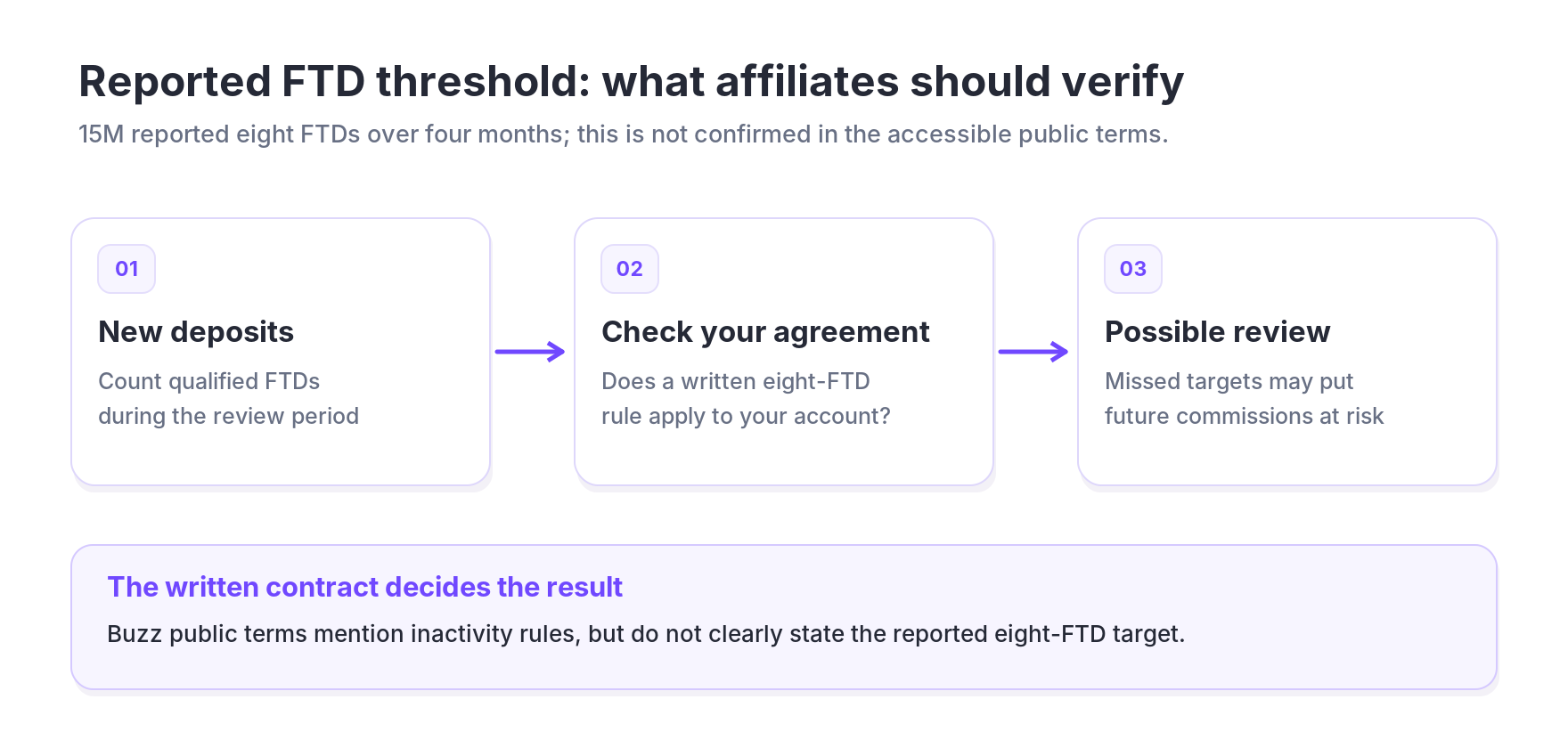
On October 12, 2026, 15M reported that Buzz Affiliates may end RevShare deals if affiliates bring fewer than eight new depositing players (FTDs) within four months.
This exact rule is not confirmed in Buzz Affiliates' public terms. Still, the terms include rules about inactivity and ending agreements, which could affect future affiliate commissions.
Key Takeaways for Casino Affiliates
RevShare is not always protected for life. Future commissions from existing players may stop if an affiliate agreement ends.
The eight-FTD target is reported, not independently confirmed in the accessible public terms. Affiliates should check their own signed agreement.
No minimum for a commission withdrawal does not mean no activity rules. Payment eligibility and contract termination are different issues.
Get the treatment of existing players in writing before sending substantial traffic to a casino affiliate program.
What Do Buzz Affiliates' RevShare Terms Actually Say?
The 15M article published on October 12 describes an eight-FTD requirement across four months. It does not establish that every Buzz partner has the same condition or that a specific affiliate has already lost commissions because of it.
The accessible Buzz Affiliates terms and conditions say something more specific:
Section 3.2: No set number of new active customers is required to withdraw eligible affiliate fees, although a minimum payment balance applies.
Section 3.13: A RevShare affiliate that fails to bring traffic for four months or longer may forfeit their position.
Section 6.7: The company also reserves the right to terminate an account after six continuous months of inactivity without traffic.
Section 6.1: Either party can end the agreement with 24 hours' notice, with or without cause.
The four-month and six-month inactivity clauses use different periods. Neither publicly visible clause sets out an eight-FTD count. Affiliates should ask Buzz which rule applies to their account and whether a separate insertion order adds a deposit target. This is an issue of contract terms , not a new gambling law.
Can Casino Affiliates Lose RevShare From Existing Players?
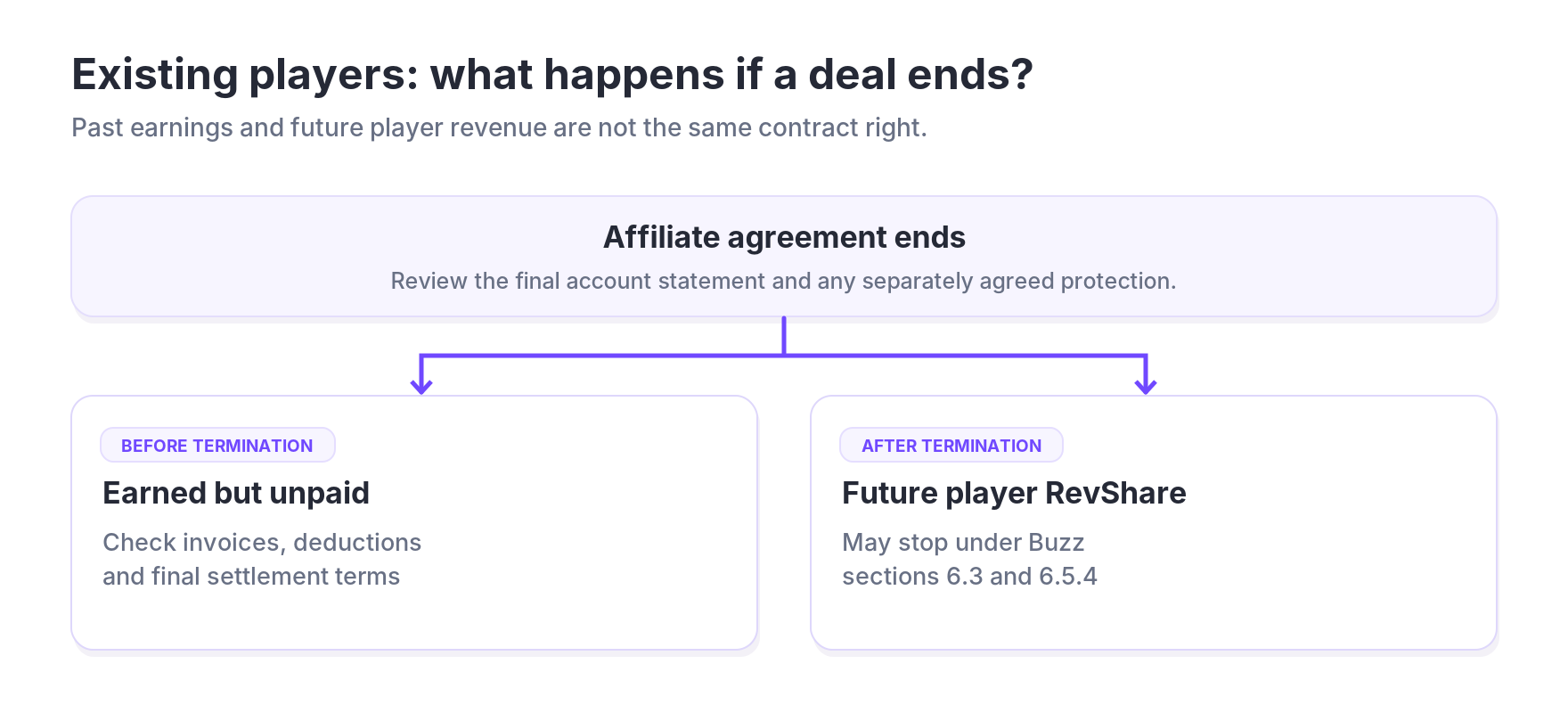
Yes, future RevShare from players you already referred can be at risk after termination, depending on the contract. Buzz Affiliates' published section 6.3 says that affiliate fees stop after an agreement ends, even if tracking links still work, unless the parties have agreed otherwise. Section 6.5.4 also limits further fees connected with referred customers after termination.
There is a difference between three types of commission:
Already paid commission: Money paid for earlier periods is not automatically the same as future revenue rights. Other contract rules, such as fraud adjustments, may still apply.
Earned but unpaid commission: Check the payout, invoicing, deductions and termination clauses. The publicly visible terms do not give every possible account a simple guaranteed outcome.
Future commission from existing players: Under sections 6.3 and 6.5.4, this can stop after termination unless a separate agreement protects it.
That distinction matters for SEO publishers and community affiliates. An old player may remain active long after the content that brought them in was published. If the affiliate deal ends, that activity may no longer generate a payment for the publisher.
Why Minimum FTD Targets Can Put Long-Term RevShare at Risk
FTD means first-time deposit : a new player makes their first qualifying deposit. Operators use FTD counts to measure acquisition, but RevShare income also depends on what referred players do over time.
Imagine a casino SEO site that brings seven qualified FTDs in four months. Its older referred players are still active and generate net gaming revenue (NGR). If that publisher's individual contract requires eight FTDs to keep the deal, it could face a review despite the activity of those older players. This is a hypothetical example, not a confirmed Buzz enforcement case.
The exposure is highest when a publisher has strong player retention but uneven new deposits. Seasonality, search traffic changes and a small audience can all affect new FTD counts. High player value does not cancel a minimum-acquisition clause when the contract makes it a condition of continued participation.
Which Casino Affiliate Terms Should You Check Before Joining?
A headline RevShare rate tells you how commission is calculated while the agreement works. It does not tell you how long the right to receive that commission lasts.
Contract term | What the affiliate should ask |
|---|---|
Minimum FTD or traffic requirement | Is there a target, how is the period measured, and what happens if I miss it? |
Qualifying player definition | Which deposits count, and can fraud, KYC or GEO restrictions remove an FTD? |
Existing-player commissions | Do commissions from previously referred players continue after termination? |
Termination and notice | Can the operator end the deal without cause, and how much notice is required? |
Payment and invoice rules | What happens to accrued but unpaid fees, and are there invoice deadlines? |
Separate written terms | Can an insertion order protect my rates or existing player commissions? |
Also check how NGR is calculated, whether negative carryover applies, and how the operator can change its terms. Buzz's published section 6.6 says a separate agreement or insertion order can take priority over the standard terms. That makes a clearly written exception especially useful.
How Can Casino Affiliates Protect Their RevShare Income?
Start with the contract you already have , not only the offers you might join next.
Save your current terms and insertion order. Keep a dated copy of the commission and termination clauses, plus any written changes.
Track new FTDs and older-player revenue separately. If acquisition is slowing, you can identify a possible target shortfall before it becomes a contract discussion.
Ask about commission rights after termination. Request a written answer covering existing players, outstanding balances and notice periods.
Compare deals before moving traffic. A higher RevShare percentage may be worth less if your ability to receive future commissions is easier to end.
Some affiliates may prefer a Hybrid deal , combining a qualified acquisition payment with recurring commission. A Hybrid structure does not remove contract risk, so its termination and player-qualification rules still need review.
FAQ: Casino Affiliate RevShare and FTD Requirements
Does Buzz Affiliates require eight FTDs in four months?
15M reported an eight-FTD threshold on October 12, 2026. The publicly accessible Buzz terms reviewed for this article mention four months without traffic in section 3.13 and six months of inactivity in section 6.7, but do not clearly state that exact eight-FTD requirement. Affiliates should confirm the rule and its start date in their own written agreement.
Can an affiliate lose lifetime RevShare?
Yes, if the affiliate agreement allows commissions to end after termination. A "lifetime" description is not enough on its own. Check whether the contract promises ongoing commission from existing players after the partnership ends and whether there are exceptions for inactivity or missed targets.
What happens to commissions already earned before termination?
That depends on the payment and termination terms, any deductions, the specific agreement and applicable law. Earned but unpaid fees should not be confused with commissions that would arise from future player activity. Ask the operator for a final statement and written confirmation of any outstanding balance.
Can a small casino affiliate negotiate minimum FTD requirements?
An affiliate can ask for a written exception, a longer review period or protection for existing-player commissions. The operator does not have to accept the request, but a clear insertion order is stronger evidence of the deal than an informal promise. Ask before committing long-term traffic.
Choose Casino Affiliate Deals That Fit Your Traffic
Casino affiliates need more than a competitive RevShare percentage. They need to know the acquisition targets, how existing players are treated, and what happens if the partnership ends.
Paynura connects affiliates with opportunities across casino, sportsbook, poker and eWallet programs. If you're comparing RevShare, CPA or Hybrid deals, speak with the team about the terms that fit your traffic model and review the applicable agreement before joining an offer.