

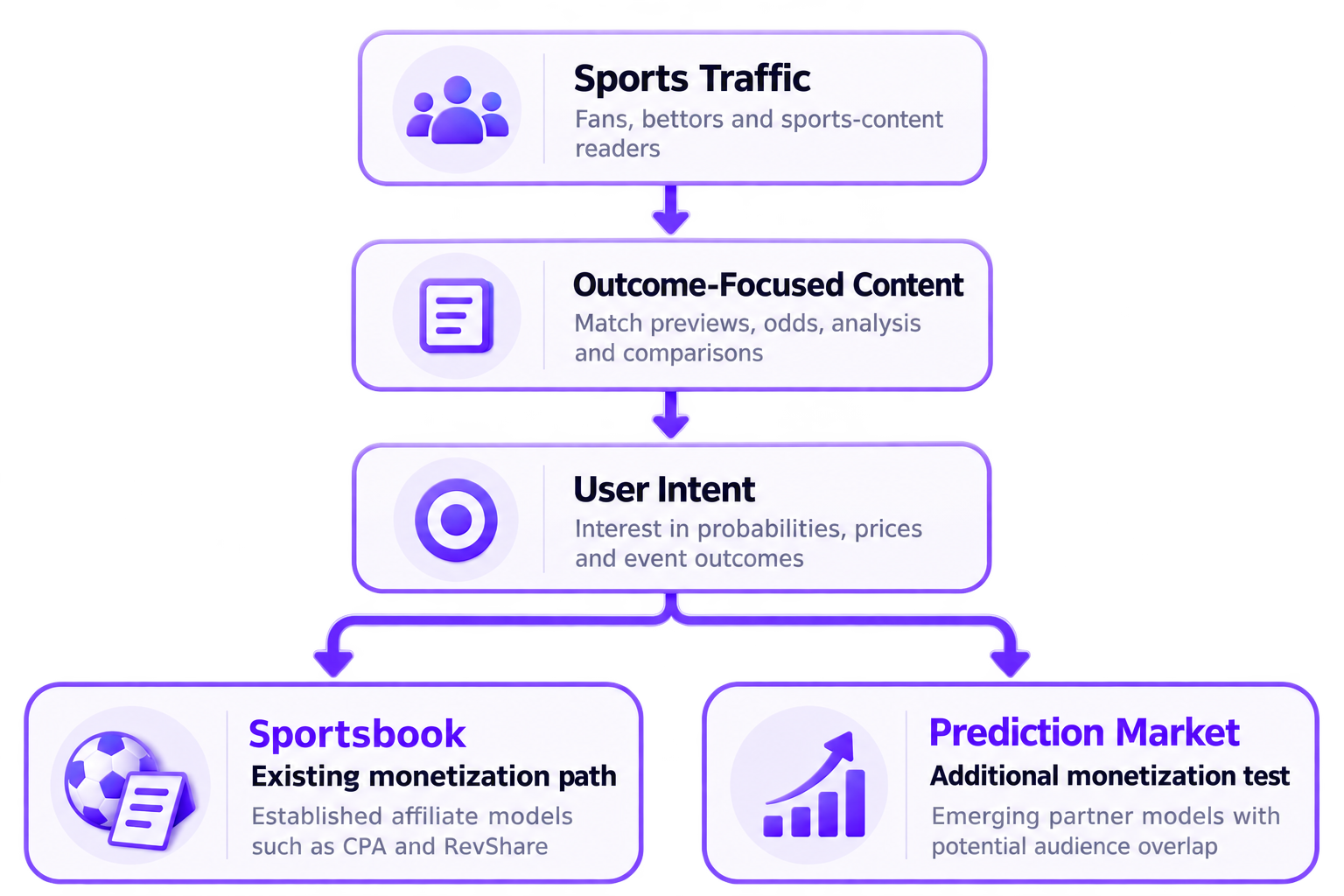
Sportsbook affiliates already spend time and money building audiences around matches, odds, statistics and likely outcomes. Prediction markets may give some of that same traffic another place to go.
That is why a new partnership between FairPlay Sports Media and WagerWire is worth watching.
On 23 September 2026, FairPlay announced a strategic partnership with WagerWire that gives it the ability to market and promote Wire Markets, WagerWire’s international prediction-market platform, across selected brands and its wider media network. FairPlay also made a strategic investment in WagerWire.
For affiliates, the interesting part is not the investment itself. It is the traffic logic behind the deal.
FairPlay already reaches sports fans who research odds and compare possible outcomes. Prediction markets could give publishers with similar audiences another way to monetize that intent alongside traditional sportsbook offers.
Key Takeaways
Prediction markets could become an additional monetization route for affiliates that already own high-intent sports traffic.
The clearest overlap is likely to be users who already read match previews, compare odds, follow sports data or research possible outcomes.
Prediction markets should not be treated as an automatic replacement for sportsbook offers. They are better viewed as another product to test against your existing traffic.
Affiliate economics can differ from standard sportsbook CPA, RevShare or Hybrid deals, so the payment model needs to be checked before sending meaningful volume.
GEO eligibility, regulation, tracking and the exact conversion event can all affect whether a prediction-market campaign is commercially useful.
The right test is simple: compare the new offer with your existing sportsbook placements using metrics such as EPC, registration rate, qualified conversions and revenue per visitor.
Could Your Existing Sportsbook Traffic Work for Prediction Markets?
Possibly.
A sportsbook user and a prediction-market user are not identical, but there is a clear area of overlap. Both can be interested in the probability of an event and in comparing possible outcomes before taking action.
Think about the traffic already landing on a football match preview, an odds comparison page or a sports statistics article. That user is already asking questions such as who is more likely to win, what the market is expecting, whether the price has moved, or whether one outcome is being valued differently from another.
That type of intent can fit a sportsbook. It may also fit a prediction market.
This does not mean every sportsbook visitor will convert on a prediction-market product. It means affiliates with relevant sports traffic already have an audience that may be worth testing.
What FairPlay and WagerWire Are Doing
FairPlay Sports Media announced its partnership with WagerWire on 23 September 2026.
Under the agreement, FairPlay can market and promote Wire Markets across selected brands and integrate it into its wider media network. FairPlay said the goal is to connect prediction markets with sports fans who are already researching odds and comparing outcomes.
Wire Markets is designed as a prediction-market marketplace. According to FairPlay, it aggregates available order books and routes trades to the best available price.
The partnership matters because it connects three things that affiliates already understand:
content → audience intent → monetization
Sports publishers create content. Users arrive with a reason for reading it. A commercial product is then placed close to that intent.
The difference is that the product does not have to be limited to a sportsbook.
Why This Matters If You Already Have Sportsbook Traffic
A sportsbook affiliate normally sends sports traffic into one or more betting offers.
Prediction markets create the possibility of a second route.
A publisher covering football, basketball or another major sport may already have pages with strong commercial intent: match previews, team comparisons, odds pages, injury news, statistics and event analysis.
That audience does not have to be rebuilt from zero.
The affiliate can test whether part of it also responds to a prediction-market offer.
This is especially interesting for publishers that already segment traffic by page type, GEO, device or user intent. Instead of replacing an existing sportsbook CTA, they can run a controlled test and compare the results.
You May Already Have the Right Audience
The strongest starting point is not “sports traffic” in the broadest sense.
It is traffic that already shows interest in probabilities, prices and outcomes.
A visitor reading a general sports-news story may behave very differently from someone comparing odds five minutes before a match.
That distinction matters.
Prediction markets are more likely to be commercially interesting when the content already attracts users who want to act on what they think will happen next.
One Sports User Can Have More Than One Monetization Path
Affiliates already do this across iGaming.
The same audience may be monetized through a sportsbook, an eWallet, a casino cross-sell or another relevant product when the fit is strong.
Prediction markets add another possible path.
The value is not in adding as many links as possible. The value is in finding out whether a new product earns incremental revenue from traffic you already own.
Prediction Markets vs Sportsbooks: What Changes for an Affiliate?
Affiliate question | Sportsbook | Prediction market |
|---|---|---|
What is the user doing? | Placing a bet with an operator | Trading a contract based on an event outcome |
Can sports content fit? | Yes | Potentially, especially outcome-focused content |
Can existing sports intent be useful? | Yes | Potentially |
How does the affiliate earn? | Often CPA, RevShare, Hybrid or another agreed model | Depends on the platform or referral arrangement |
What must be checked? | Qualification rules, NGR, deductions, GEOs and tracking | Eligibility, payment model, conversion event, GEOs and tracking |
How mature is the affiliate model? | Well established | Still developing across many platforms |
What should you compare? | EPC, FTDs, CPA value, RevShare and player value | EPC, qualified conversion rate, revenue per visitor and repeat activity where relevant |
The biggest commercial difference is maturity.
Sportsbook affiliates already understand common models such as CPA and Revenue Share. Prediction-market platforms do not all use the same structure, and some may offer referral arrangements rather than a classic affiliate program.
Do not assume that a prediction-market signup is worth the same as a sportsbook FTD.
Check how the program pays, what makes a user qualify, how long attribution lasts and whether the economics still work after traffic costs.
For a platform-level example of how prediction-market referral structures can differ, see Paynura’s Kalshi vs Polymarket for Affiliates comparison.
Where Prediction Markets Could Fit Into Existing Sports Content
The most sensible placements are pages where the user is already thinking about an outcome.
That can include:
pre-match previews;
odds and price comparison pages;
sports statistics pages;
event analysis;
tournament or championship coverage;
team or player comparison pages;
sports-news stories with strong outcome intent.
The prediction-market placement should match the page.
A user reading a Champions League match preview has different intent from someone reading a club transfer story. Treating both users the same can hide whether the product really works.
Start with the pages that already produce strong sportsbook engagement.
Then compare.
What Should You Measure Before Sending More Traffic?
Do not judge the test by clicks alone.
A prediction-market link can get attention without producing useful affiliate revenue.
Track the full path where the program gives you enough data:
Click-through rate: Are users interested enough to leave the page?
Registration rate: How many referred users create an account?
Qualified conversion rate: How many complete the action required for affiliate credit?
EPC: How much affiliate revenue is produced per click?
Revenue per visitor: Does the new placement add value to the page as a whole?
GEO performance: Does the offer work better in some eligible markets than others?
Repeat activity: If the commission model rewards ongoing activity, do referred users return?
Tracking quality: Can you reliably connect the conversion to the page, campaign and traffic source?
Then compare those results with the sportsbook placement you already use.
You are not trying to prove that prediction markets are “better.” You are trying to find out whether they add useful revenue to your own traffic.
If you need a refresher on attribution before setting up a test, Paynura’s tracking guide explains how affiliate clicks and conversions are connected.
The Biggest Limitation: Prediction Markets Are Not Just Another Sportsbook
The products can look similar from a distance because both involve future outcomes. The regulatory and commercial setup can be different.
Wire Markets, according to FairPlay’s announcement, has received approval in principle from HM Government of Gibraltar. Gibraltar introduced its Prediction Market Regulations 2026 on 13 July 2026, creating a dedicated regulatory framework for prediction-market activity.
That does not make every prediction-market platform available in every country.
Affiliates still need to check:
where the platform can accept users;
where the affiliate is allowed to promote it;
whether local advertising rules apply;
what the platform considers a qualified referral;
whether paid traffic, SEO, email, social or other channels are permitted;
whether the program has restrictions on claims or promotional wording.
Do this before building a large campaign around the product.
Should Sportsbook Affiliates Test Prediction Markets?
For some affiliates, prediction markets are worth investigating now. For others, the setup may still be too early.
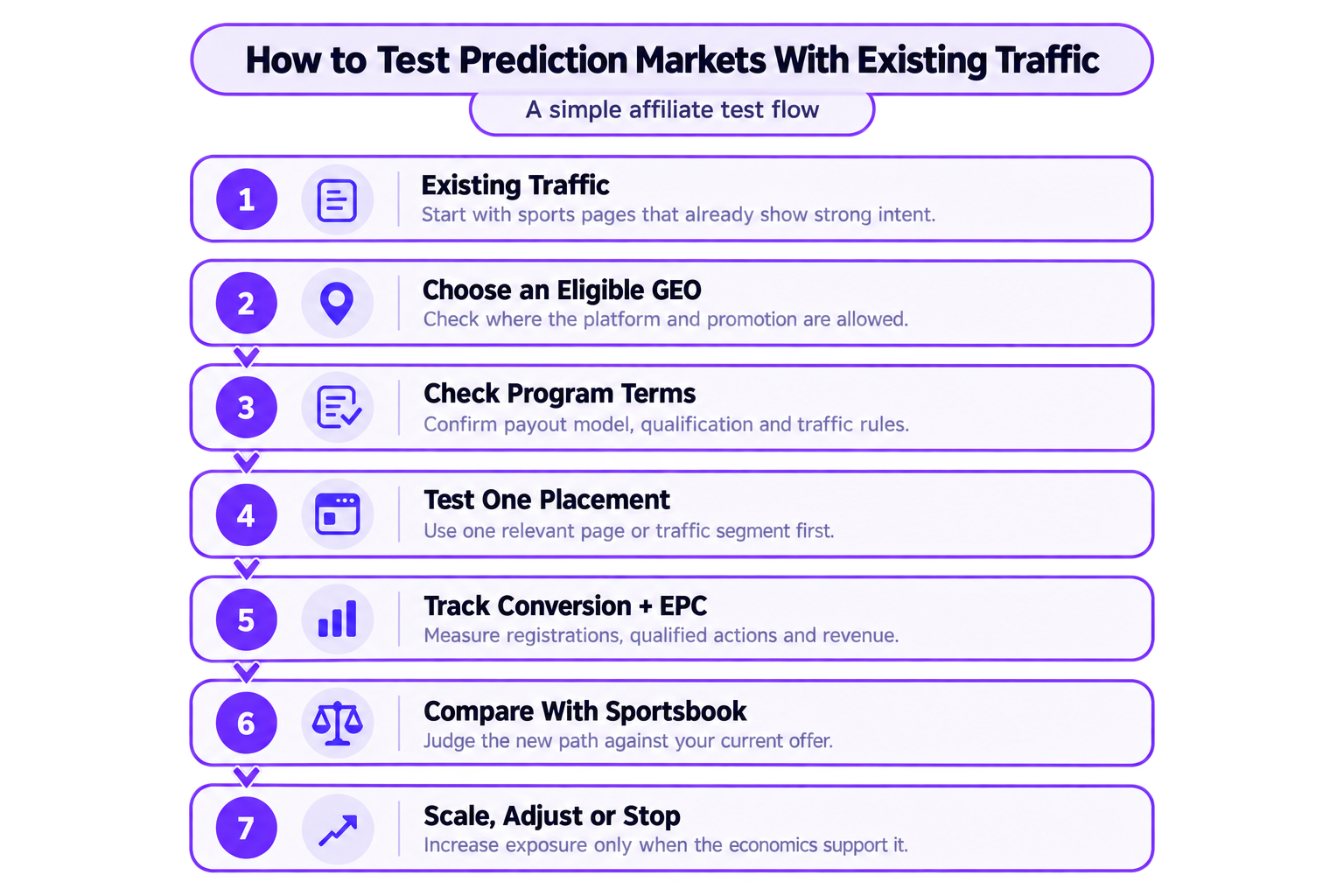
A test makes more sense when you already have outcome-focused sports traffic, eligible GEOs, a clear monetization agreement and tracking that lets you measure the result.
It makes less sense when the payment model is unclear, your audience is outside supported markets or you cannot separate prediction-market performance from the rest of your traffic.
A small test can answer more than a broad industry trend.
Use one traffic segment. Pick a relevant placement. Track it separately. Compare the economics with your current sportsbook offer.
Then decide whether it deserves more space.
What Affiliates Should Watch Next
The FairPlay and WagerWire partnership is one example of prediction markets moving closer to mainstream sports media.
The next question is whether more publishers follow the same route.
Affiliates should also watch how prediction-market partner programs develop. Classic sportsbook affiliate marketing has established payment models, tracking systems and performance metrics. Prediction-market monetization is still less standardized.
Three developments will matter most:
whether more platforms launch serious affiliate or publisher programs;
whether GEO access becomes clearer and broader;
whether campaign data shows that prediction markets add revenue rather than simply move users away from existing sportsbook offers.
That last point matters the most to an established sportsbook affiliate.
New revenue is useful. Moving an existing conversion from one link to another without improving the economics is not.
FAQ
Can sportsbook affiliates promote prediction markets?
Sportsbook affiliates may be able to promote prediction markets when the platform accepts affiliate or referral traffic, the target GEO is supported, and the promotion complies with local rules and the platform’s terms. Affiliates should verify those conditions before sending traffic because prediction-market availability and advertising rules can differ between jurisdictions and platforms.
Are prediction markets the same as sports betting?
No. They can overlap because both may involve sports outcomes, but the product structure can be different. A sportsbook normally offers bets and sets or manages betting prices, while a prediction market can allow users to trade contracts linked to whether an event happens. The exact legal treatment also depends on the jurisdiction.
Can I use existing sportsbook traffic for prediction markets?
You can test prediction-market offers with existing sportsbook traffic when the audience and content are relevant. Traffic from odds comparisons, match previews, sports statistics and outcome-focused analysis may have a stronger fit than broad sports traffic. The useful question is whether the new placement produces qualified conversions and commercially useful revenue without damaging the performance of your existing sportsbook offers.
Should prediction markets replace sportsbook affiliate offers?
There is no strong reason to treat prediction markets as a general replacement for sportsbook affiliate offers. Sportsbook monetization is already established, while prediction-market partner models are still developing. A more practical approach is to test prediction markets as an additional monetization route and compare the results with your current sportsbook traffic before changing larger parts of your site or campaign.
What metrics should I compare between a sportsbook and a prediction-market offer?
Compare metrics that show both conversion and commercial value. Useful measures include click-through rate, registration rate, qualified conversion rate, EPC, revenue per visitor, GEO performance and repeat activity where it affects commission. The exact comparison should also reflect how each program pays because a sportsbook CPA deal cannot be evaluated in the same way as a fee-share or other referral model.
The Affiliate Takeaway
The FairPlay and WagerWire partnership does not prove that prediction markets will earn more than sportsbooks.
It shows something more useful for affiliates: sports media companies are starting to connect existing sports intent with prediction-market products.
If you already own sportsbook traffic, that gives you a clear question to test.
Can part of the audience you already acquired support another monetization path?
Start with a small, measurable test. Check the GEO and program rules first. Track the new placement separately. Compare the economics with your existing sportsbook offer.
If the numbers work, you have another way to use traffic you already own.
If they do not, your sportsbook strategy stays intact.
Want to compare established iGaming affiliate opportunities before testing a new traffic path? Become a Paynura partner and review available affiliate deals with your account manager.