

Brazil is considering tighter betting ad and sponsorship rules. PL 2,470/2026 could affect affiliate traffic, promotions and campaigns across the Brazilian betting market.
Brazil’s betting advertising rules could change again.
On September 2, 2026, the Senate’s Science and Technology Committee approved a substitute version of PL 2,470/2026. The proposal would sharply restrict betting advertising, affiliate promotion and sponsorship.
The proposal is not law.
As of September 18, the Senate lists it as awaiting a rapporteur in the Social Affairs Committee. For an affiliate marketer in Brazil, that distinction matters. Campaigns still operate under the rules already in force, while PL 2,470/2026 could change how betting traffic can be acquired.
For Paynura affiliates, the first question is simple: how much of your Brazil traffic comes from channels named in the proposal?
Key takeaways for affiliates
PL 2,470/2026 is not law. Brazilian affiliates can continue running campaigns that comply with the rules currently in force.
The proposal would place much broader restrictions on betting promotion and expressly covers affiliate content, tipsters and comparison sites.
SEO, paid search, social media, influencers, messaging and other online acquisition channels could all be affected if the proposal becomes law.
CPA, RevShare and Hybrid deals could react differently to tighter acquisition rules, so affiliates should know how much revenue depends on new FTDs versus existing players.
For now, affiliates should promote only authorised operators, follow current advertising requirements and segment Brazil traffic and revenue by channel so they can see where exposure is highest.
What has happened so far
The Science and Technology Committee approved PL 2,470/2026 in substitute form on September 2. It also approved a request for urgent consideration.
The bill then moved to the Social Affairs Committee.
It still needs further legislative action before it can become law.
A Brazilian affiliate marketer does not need to stop a compliant campaign because of the committee vote. But this is a good time to check how exposed your traffic mix would be if the proposal moves forward.
What the proposal would restrict
The committee text would prohibit direct or indirect betting marketing across television, radio, print, outdoor media, streaming, podcasts, social networks, video platforms, apps, websites, blogs, forums, search engines and other online environments.
It would also cover instant messaging, SMS, email, notifications, algorithmic targeting, remarketing and behavioural profiling.
Affiliate content is named directly
This is one of the most relevant parts for gambling affiliates in Brazil.
The text expressly names affiliate content, tipsters, comparison sites and other paid intermediaries among the proposed restrictions.
That could affect SEO publishers, paid-media teams, sports-tip communities, influencers and comparison businesses.
If your affiliate Brazil strategy uses several of these channels, your acquisition mix could need to change if the bill becomes law.
The proposal would still allow limited institutional communication through an authorised operator’s own channels. Promotional invitations and retention-focused marketing would be restricted.
Bonuses and sponsorship could face new limits
The substitute would prohibit bonuses, promotional credits, free bets, cashback, free spins, rewards and loyalty programmes when they are used to stimulate sign-up, continued play or return to betting.
It would also prohibit betting-company sponsorship across sports clubs, federations, leagues, competitions and sports broadcasts, among other areas.
Brand exposure, naming rights, licensing and ambassadors are included. Existing sponsorship contracts would have a proposed 24-month adjustment or termination period.
For betting in Brazil, that could reduce a major source of brand visibility around football.
Brazil already has stricter betting ad rules
PL 2,470/2026 is not the starting point for Brazil betting regulation.
For broader market-entry and PIX context, Paynura’s Brazil iGaming Affiliate Playbook 2026 covers the regulated market in more detail.
Since July 17, Portaria SPA/MF 1,964 has required fixed-odds betting ads to carry a prescribed Ministry of Finance risk warning. The warning must be horizontal, legible and cover at least 10% of the advertisement.
Interministerial Portaria 73 applies across the advertising chain. That includes people and companies that produce, promote, sponsor, boost or publish betting advertising.
It prohibits promotion of unauthorised operators and expressly covers affiliate links and promo codes leading to unauthorised platforms.
Before an ad is published or boosted, the advertiser’s authorisation must be checked against the official SPA list.
CONAR also approved an Annex X update on August 27 with stronger monitoring expectations for influencer and affiliate advertising and a proposed credentialing programme.
Area | Current position | PL 2,470/2026 proposal |
|---|---|---|
Betting ads | Permitted under federal and self-regulatory restrictions | Broad prohibition across many media and internet channels |
Affiliate promotion | Affiliates already sit within the advertising responsibility chain | Affiliate content, tipsters and comparison sites expressly covered |
Operator checks | Unauthorised operators cannot be promoted; authorisation must be checked | Much narrower room for commercial communication |
Risk warnings | Mandatory warning must occupy at least 10% of an ad | Operator-owned channels largely limited to institutional information |
Sponsorship | Still possible under the current framework | Broad proposed ban with a 24-month adjustment period |
What this could mean for affiliates in Brazil
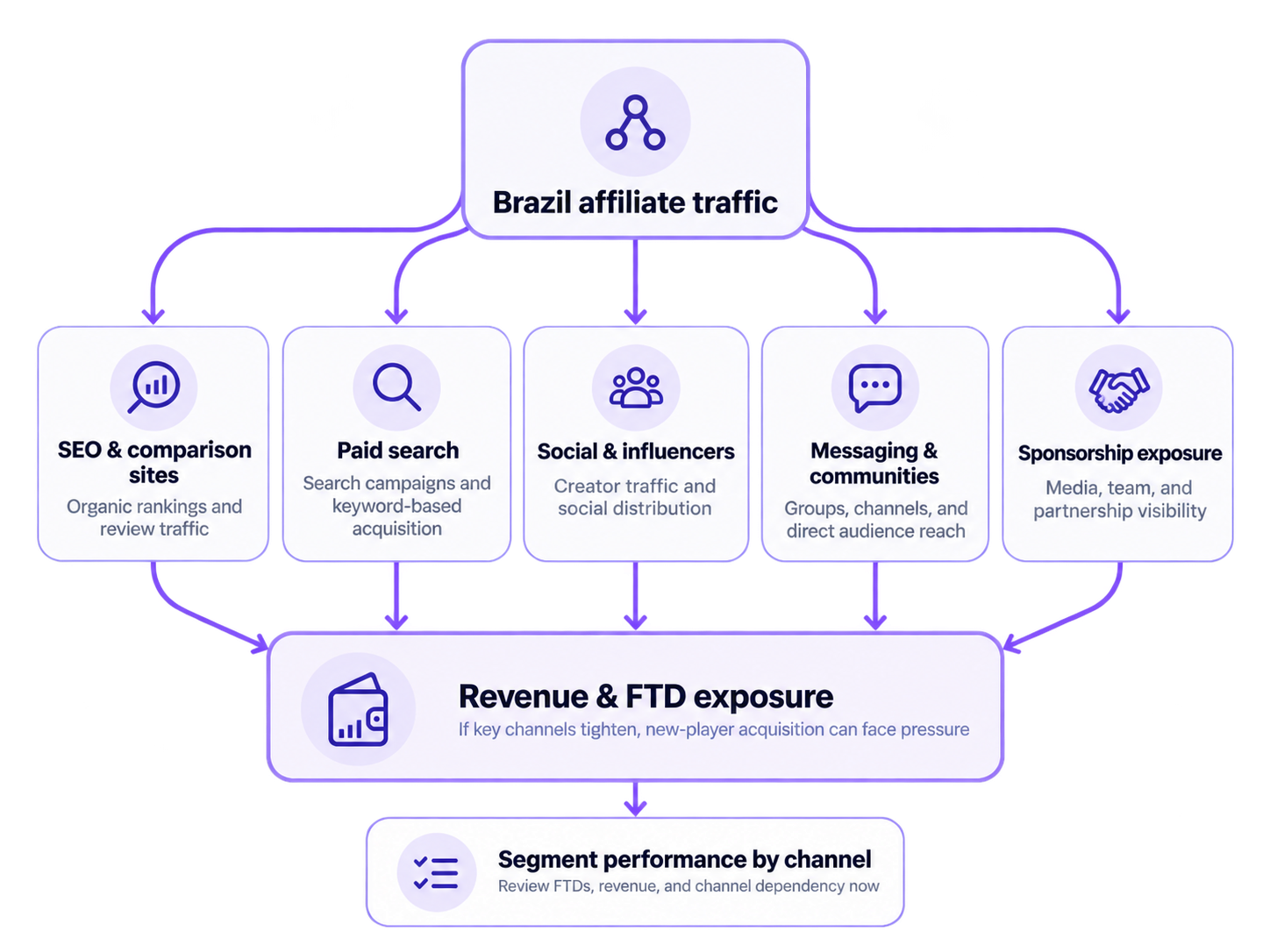
Which traffic sources could be affected
A sportsbook comparison site, Telegram tipster, influencer partnership and paid-search campaign use different acquisition models.
But the committee text reaches all of them.
Segment your Brazil revenue and FTDs by channel now.
That will show which parts of your business could be most exposed if the proposal advances.
How CPA, RevShare and Hybrid could be affected
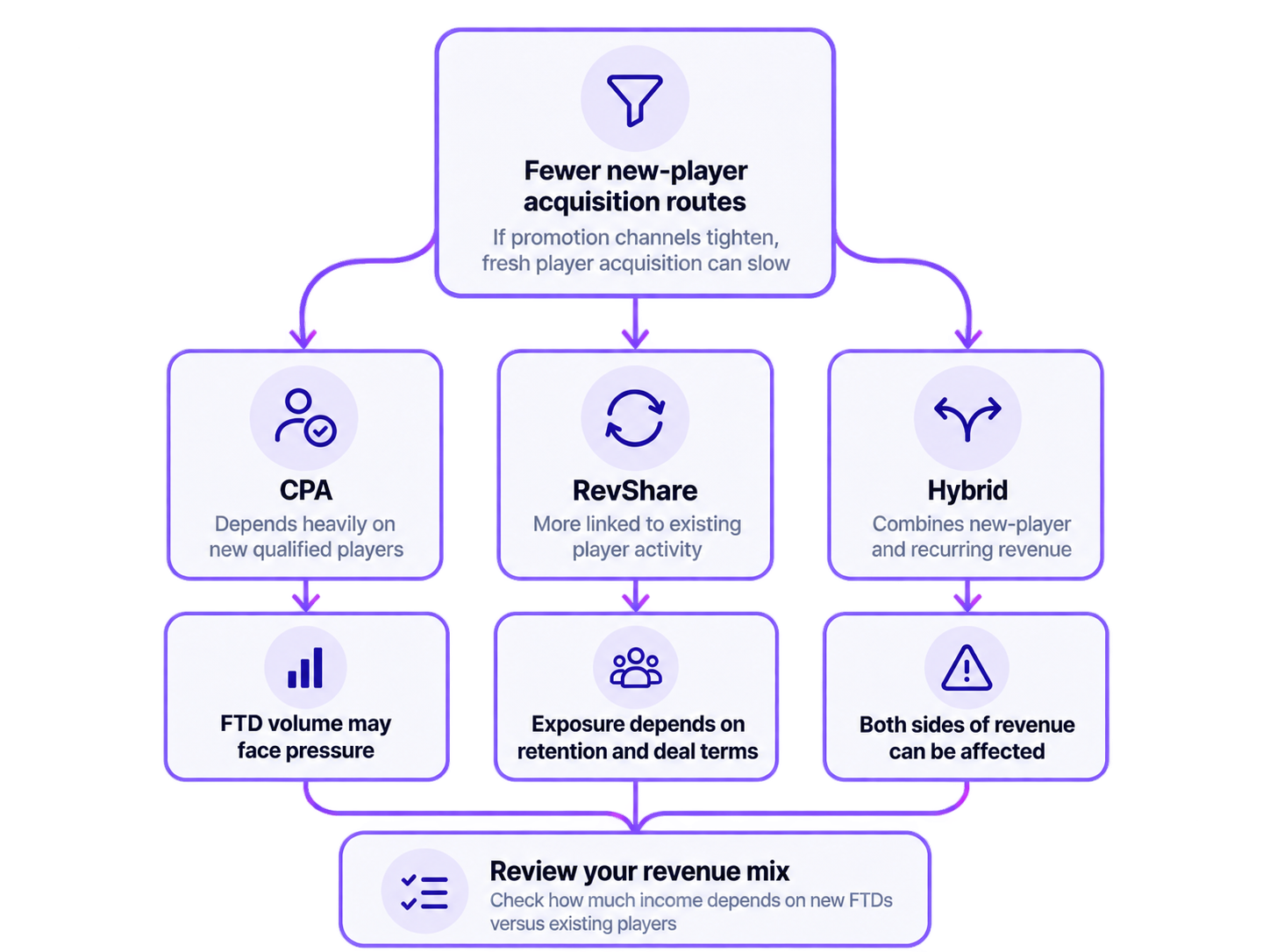
The effect could look different depending on how you are paid.
CPA depends on new qualified players, so fewer acquisition routes could put pressure on volume.
RevShare depends more on player activity over time, subject to the terms of each deal.
Hybrid combines both types of exposure.
That does not make one commission model automatically better.
A Brazil affiliate should know how much income depends on fresh FTDs and how much comes from an existing player base.
Paynura can help affiliates look at traffic source, GEO, operator fit and commission structure together rather than treating every Brazil offer as interchangeable.
Affiliates comparing their deal structure can also use Paynura’s Revenue Share and Hybrid deal guides.
Sponsorship changes could affect conversion before the click
If betting sponsorship is reduced, affiliates may lose some of the brand familiarity built around teams, competitions and broadcasts.
That could make operator selection more important before a visitor even reaches your affiliate link.
Factors such as authorised status, local product fit, payment support and tracking quality may carry more weight.
What affiliates should do now
Segment Brazil revenue and FTDs by SEO, paid search, social, influencer, messaging and comparison traffic.
Check that every promoted operator is authorised for Brazil.
Review creatives against the July warning requirements.
Remove links or promo codes pointing to unauthorised operators.
Review affiliate, influencer and sponsorship contracts for regulatory-change clauses.
Keep creative approvals and adult-targeting safeguards documented.
Keep channel-level attribution clean; Paynura’s tracking guide explains the main tracking methods used in iGaming affiliate campaigns.
Compare how CPA, RevShare and Hybrid income would react to lower new-player volume.
Avoid long campaign commitments that assume today’s advertising rules will remain unchanged.
What happens next
PL 2,470/2026 remains with the Senate, and its text can still change.
The Secretariat of Prizes and Betting also lists a separate review of affiliate advertising in internet applications as “in development” in its 2026–2027 regulatory agenda.
Brazilian affiliate marketers therefore have two regulatory tracks to follow: Congress and the SPA.
Campaign decisions should be based on the rule in force when the campaign runs, not on the assumption that the proposal will pass unchanged.
FAQ
Is betting advertising currently banned in Brazil?
No. Betting advertising is permitted under federal and self-regulatory restrictions. PL 2,470/2026 proposes much broader limits, but it has not become law.
Does the proposal cover gambling affiliates in Brazil?
Yes. The committee-approved text expressly names affiliate content, tipsters, comparison sites and other paid intermediaries.
Could betting sponsorships disappear from Brazilian football?
The proposal would broadly prohibit betting-company sponsorship of clubs, leagues, competitions, broadcasts and other sports-related entities.
Existing contracts would receive a proposed 24-month adjustment period.
The measure is not yet law.
What should a Brazilian affiliate marketer follow today?
Promote authorised operators, follow applicable advertising restrictions, use the required risk warnings where relevant, avoid marketing directed at minors and comply with rules that apply across the advertising chain.
How Paynura can help Brazil-focused affiliates
Brazil remains a regulated iGaming market, but advertising access is becoming a bigger part of the commercial calculation.
For gambling affiliates in Brazil, the immediate work is practical: stay with authorised operators, keep campaigns compliant and know which traffic sources could be affected by new restrictions.
Paynura helps affiliates compare sportsbook and casino opportunities by GEO, traffic type and commission model while Brazil betting regulation develops.
If you are active in Brazil or planning to enter the market, speak with your Paynura affiliate manager and review which offers fit your traffic model before committing more campaign budget.